
The fantastic story of László Kubala
Today, high-profile football players are more than just athletes; they are social phenomena, equaling actors and musicians with their celebrity status, as well as leading lifestyles worthy of movie stars. While László Kubala's case didn't reach that level at the time, it's true that his career was that of a star who caused a stir wherever he went and left no one indifferent. Although communism prevented him from being part of that famous Mighty Magyars team from Hungary that amazed the world, he was one of the best players in the world in the 50s.However, and unlike other stories of football players or managers that we have had, Kubala's is a life story like few others. Everything surrounding Kubala's career had a cinematic quality, from his early days in his native Hungary to his arrival in what would become his second home, Spain. That's why, despite all the great stories we have about Kubala, we have been forced to leave out many of the great moments in his life.
©
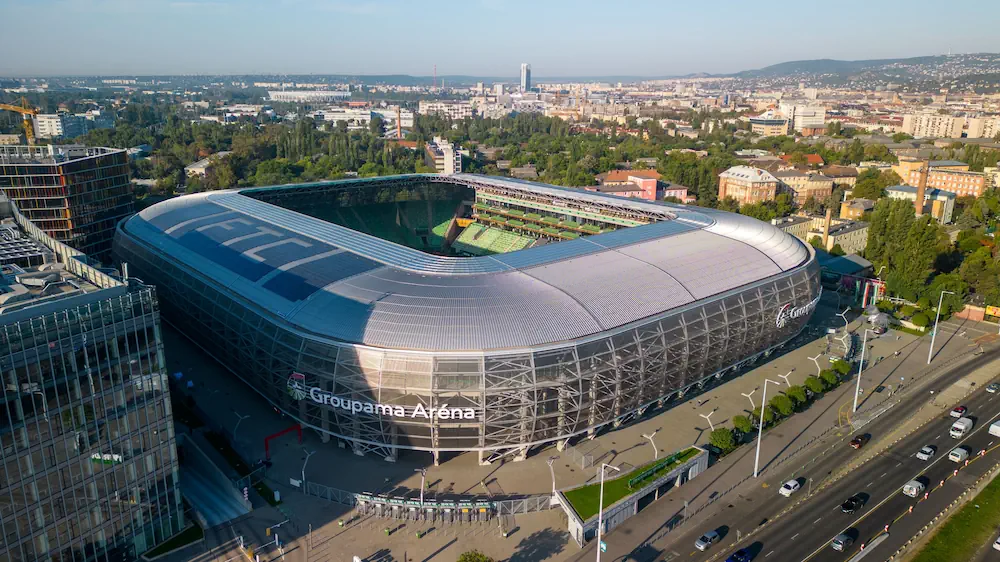
Groupama Arena Football Stadium - today the home arena of Kubala's first professional club Ferencváros
The Beginning of his Career
Ladislao Kubala Stecz was born on June 10, 1927, in Budapest, Hungary, to a Slovak mother (with Polish roots) and a Slovak father (at that time, Czechoslovakia), something that already gave indications of what his future could hold in terms of the nationalities and countries in which he would live and represent. At just 10 years old, he was already playing football at a school in the Hungarian Football Federation and within a couple of years he moved to GANZ, a factory team that played in the third tier of Hungarian football. There he played with children several years older than him. When he turned 18, he was signed by Ferencváros, where he only stayed for a year, leaving a great impression, scoring 33 goals in 49 matches (bear in mind that the statistics at the time were a bit difficult to follow though) and earning a call-up to the Hungary national team.In 1946, he moved to Slovan Bratislava, reportedly to avoid military service in his home country. His performance was still very high, and this led to his being called up to play for the Czechoslovakia national team. After two years, he decided to return to Hungary to play for Vasas SC, which not only marked his return to his home country's football but also to the Hungarian national team (those were different times; FIFA didn't have strict rules regarding switching national team).
A Life Far from Home
In 1949, communism arrived in Hungary when the Soviet Union took over the country, and this led Kubala to decide to leave his country. It is said that he paid a group of mercenaries who smuggled people across the border into Vienna. In Kubala's case, he did so disguised as a Russian soldier in a truck that dropped him off near the Austrian border, which he had to cross on foot-something worthy of a movie, like many things in the life of the Hungarian star.The traffickers left them in the middle of a mountain to make the last leg on foot. Since the group included children, they were given pálinka, a liquor that would lull the children to sleep, since the crying of one of them could alert the sentries, who had orders to shoot to kill. Just as Kubala's group managed to cross the border, many other groups were discovered and killed by the communists.
Once in Austria, Kubala managed to contact Italian clubs such as Roma, but finally "signed" for Pro Patria. It is said that he entered the country of the boot with a false Italian passport, remembering that he was wanted by the Hungarian authorities for having fled the country. The Hungarian Football Federation vetoed any signing of Kubala in Italy, so he could only play friendly matches with Pro Patria.
In May 1949, Torino, very interested in signing him and who at that time was one of the best teams in Europe (Il Grande Torino), invited him to play for their team in a friendly in Lisbon against Benfica, in honor of Xico Ferrera, a legend of the Portuguese club. On the day his flight from Italy to Lisbon was due to leave, he found out that his wife and son had crossed the Iron Curtain and were in Udine, Italy, so he did not go with Torino to Portugal. The Torino expedition crashed, on its return from the testimonial match, into the Basilica of Superga, on a mountain near Turin, on May 4, 1949. All 31 people on that flight died.
Hungaria FbC Roma
FIFA had imposed a one-year ban on Kubala after the Hungarian Football Federation accused him of breaching his contract and breaching military service, receiving the approval of the world's governing body. This prevented the Hungarian striker from officially signing for any team during that period, a situation that alienated clubs that were interested in him. This led to Kubala joining other Hungarian refugees and other nationalities, including Poles, Yugoslavians, and Romanians, in January 1950 to form a team called Hungaria FbC Roma (or just "Hungaria") that would only play exhibition matches. The team was managed by Ferdinand Daucik, Kubala's brother-in-law, who would later have a distinguished career as a manager with teams such as FC Barcelona, Atlético Madrid, and FC Porto.Thus, the team started by playing a friendly against the Italy B national team and began touring different countries, basically, wherever they wanted to hire them, which included destinations as unusual as Colombia, which caused some Hungaria players to stay and play in Colombia. In June 1950, Hungary received a call that would change Kubala's life. On the other end of the phone was Santiago Bernabeu, president of Real Madrid, who invited the refugee team to play a few exhibition matches in Spain.
Arrival in Spain
Real Madrid was their first opponent on June 5th, and this would be a day that marked a turning point in the Hungarian star's life. At halftime, the refugee team was leading 2-1 with goals from Kubala, against a Real Madrid side that, according to the chronicles of the time, was rather weak. In the second half, as is almost customary, the Santiago Bernabeu team came back and won 4-2, although Kubala had left a very positive impression.A few days later, they defeated the Spanish team, which was preparing for the World Cup in Brazil, 2-1, again with a great performance from Kubala. Real Madrid was interested in the Hungarian and, in fact, already had a contract prepared for Kubala, and only "details" were missing to finalize the signing, details that turned out to be very decisive in the matter.
The Spanish Football Federation denied Real Madrid the opportunity to sign the Hungarian because they could not obtain an international transfer. Kubala's suspension was still active, and despite the fact that he was playing for Real Madrid, FIFA feared a stampede from Eastern European federations if the Hungarian were allowed to sign for the Spanish team.
It is said that when Kubala received Real Madrid's offer, he asked for Ferdinand Daucik to be hired as coach. Santiago Bernabeu responded by offering him the reserve team as an option, something that the Hungarian star's brother-in-law did not like. This situation, along with the difficulties in securing the player's transfer, discouraged Real Madrid from signing Kubala. A couple of days later, he traveled to Barcelona to face Espanyol. The match ended 6-4 in favor of the home team, but once again, the Hungarian striker stood out.
©
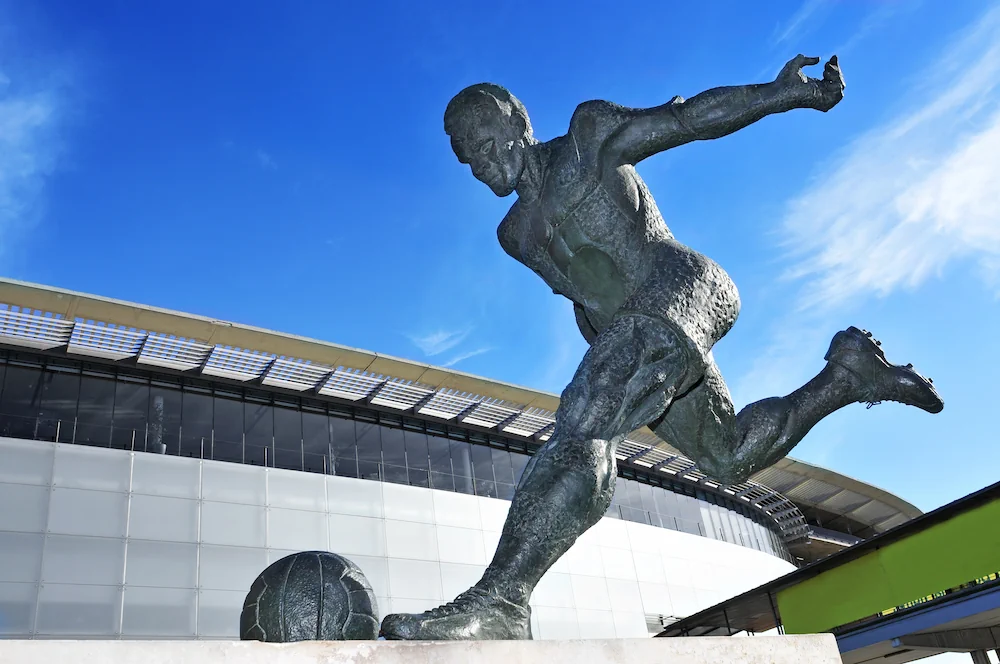
Sculpture of László Kubala outside of Camp Nou
His time at FC Barcelona
Barcelona approached Kubala about signing him, and in the negotiations, the Hungarian used the contract offered to him by Real Madrid as a reference, so the Catalan club had to make a similar offer that, in addition to the monthly salary, included a monthly bonus defined in the accounting books as "expensive living, incentives, and overfeeding." In addition to Daucik as manager.Barcelona signed him as an "amateur player" while they waited to resolve his administrative situation. Unlike Real Madrid, he had the support of the Spanish Football Federation, as the general secretary, Ricardo Cabot, was a former player for the Catalan club. In fact, he moved the Federation's headquarters from Madrid to Barcelona.
Despite having that "help," the process was slow, and Kubala could only play friendlies with Barcelona. This was starting to irritate him, to the point that he was close to leaving to play in the Colombian league, a league formed outside of FIFA and featuring names like Alfredo Di Stéfano. The offer was very good and came from Atletico Bucaramanga, and in this case, he would be able to play in every game, since the league was a "pirate league" and not governed by FIFA. This accelerated the entire process, which began with Kubala being granted political refugee status and then Spanish nationality, given that Francisco Franco's regime viewed the Hungarian as a strategic political asset. Finally, Barcelona paid financial compensation to both Vasas and Pro Patria, and with the administrative issue resolved, Kubala could finally play for the Catalan club without restrictions.
The Hungarian striker completely changed the Catalan team's game, and during his decade at Barcelona, they won four league titles, five Copa del Generalisimo titles (today Copa del Rey), two Inter-Cities Fairs Cups, and reached the European Cup final in 1961, which they lost to Bela Guttmann's Benfica. That Barcelona team boasted a spectacular attack that included, in addition to Kubala himself, his compatriots Sandor Kocsis and Zoltan Czibor, and the Spaniard Luis Suárez, the reigning Ballon d'Or winner.
In 1953, he made his debut for Spain, his third national team appearance, in a friendly against Argentina, and in an official match in 1954. That same year, he also represented the Catalan national team, although it was not recognized by FIFA. During his decade (the first because there will be more to come), he also recorded a film based on his life called "Los Ases busca la Paz" (The Aces seek Peace).
Move to the Bench
At this point, 1961, Kubala was the most important and famous person in Barcelona. The Hungarian was famous in the city for his nightlife; in fact, he did so for almost his entire career. After his retirement, naturally, he opened a bar he called Kep Duna (Blue Danube in Hungarian). It was also said to be a place that welcomed refugees from Eastern European countries. The motto in those countries was "if you manage to get through the Iron Curtain, go to Barcelona and look for Kubala, he will help you".He retired that year and took over as Barcelona's manager for a couple of seasons before moving to city rivals Espanyol, where he served as player-manager, a team that at that time included Alfredo Di Stéfano. He would hold that same role during later spells in Zurich in Switzerland and Toronto Falcons in Canada.
However, he couldn't stay away from Spain for long as he returned in 1968 to coach Córdoba and, just a year later, became the coach of the Spain national team. He is the Spanish national team coach who has served the longest time on the national team's bench (he was there for eleven years, from 1969 to 1980). His coaching career included a brief return to Barcelona, along with spells at several Spanish clubs such as Málaga, Murcia, and Elche, as well as spells abroad, including Al Hilal in Saudi Arabia and the Paraguay national team. On May 17, 2002, he died in Barcelona at the age of 74 due to a degenerative brain disease.