
Zvonimir Boban - the Milan Icon That Modric Admired
When Luka Modric was young, Boban was one of Croatia's leading figures, a star for both AC Milan (which led Modric to decide to play for the Rossoneri) and the national team. On the pitch, Boban was an elegant and well-rounded player, and off it, he was a man who enjoyed reading and studying, and who also had a strong nationalist commitment, of which he would unwittingly become a symbol.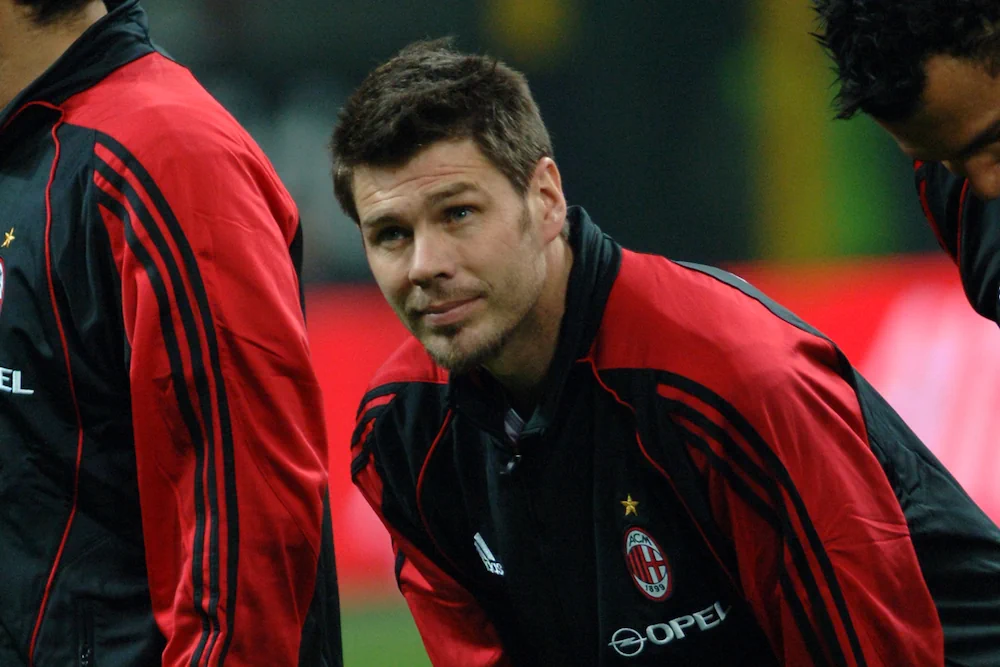
©
Zvonimir Boban in 2006
A Rising Talent in Yugoslavia
As usual, we begin by reviewing the player's origins, which in this case take us to Imotski, a Croatian town near the border with Bosnia and Herzegovina, and which, at the time of Zvonimir's birth, October 8, 1968, was part of the former Yugoslavia.Boban was always a quiet guy but with a strong personality and true to his principles, including strong nationalist feelings, in addition to being someone who has always liked to study, something that is not so common in the world of football.
At the age of 10, he started playing football at Mracaj Runovic where he would only stay for three seasons until one of the greats of Croatia noticed him, Hajduk Split. His time in Dalmatia was short though since his undeniable talent caught the attention of Dinamo Zagreb, who did not hesitate to snatch him away from their eternal rival to the 14-year-old.
In the 1985-86 season, he made his debut in the Dinamo first team at just 16 years old, playing two games that year. In 1987, he was called up by Yugoslavia to participate in the FIFA World Youth Championship (the current Under-20 World Cup), sharing a team with names that would be very important for Balkan football such as Robert Jarni (played for Juventus and Real Madrid), Robert Prosinecki (played for Real Madrid and Barcelona), Predrag Mijatovic (scored the goal of the seventh European Cup for Real Madrid) and Davor Suker (yes, you guessed it, he also played for Real Madrid, in addition to Arsenal). They were drawn into Group A, alongside Australia, Togo, and Chile (the host country), finishing first with three wins in three matches, with Boban among their key players.
In the quarterfinals, they defeated Brazil, the reigning champions, 2-1, qualifying for the semifinals where they also won 2-1, this time against Matthias Sammer's East Germany. In the final, they faced West Germany, with whom they had an extremely close match, but Boban himself managed to break the deadlock in the 85th minute. However, the Yugoslav joy was short-lived as Witeczek scored a penalty in the 87th minute. The final went to penalties, with the Balkan nation converting all five of their spot kicks, while the Germans missed one, ironically, Witeczek himself. Thus, Yugoslavia was crowned champion for the first (and only) time in the tournament's history.
At just 19 years old, he had become a cornerstone of Dinamo Zagreb, to the point of being named team captain at such a young age. In March 1990, Boban was called up by his national team to play in the UEFA European Under-21 Championship, where Yugoslavia fielded the same generation that had won the World Youth Championship, along with players like Alen Boksic (who would later play for Lazio and Juventus). In the final stage of the tournament (at that time, it was a single knockout stage with two-legged matches, following the qualifying rounds), their quarter-final opponent was Bulgaria, whom they defeated 3-0 on aggregate. In the semi-finals, they faced Italy, drawing 0-0 in Yugoslavia and 2-2 at the Ennio Tardini stadium in Parma, advancing on away goals thanks to Boban's equalizer. In the final, they faced the Soviet Union, losing 7-3 on aggregate.
A Political Symbol in Troubled Times
Yugoslavia's generation of young talent promised a bright future for the country's football, but the political context would tell a different story. On May 13, 1990, Dinamo Zagreb faced Red Star in Croatia, shortly after the country's first multi-party elections, at a time of growing political tension in Yugoslavia. Tension between the two teams already existed for sporting reasons, as they were two of the best teams in the tournament and competed for the league title every year, and this was now compounded by the political situation. Around 3,000 Serbian fans traveled to Zagreb, and several hours before the match, clashes began with Dinamo Zagreb supporters.Some of those involved in the conflict would later become involved in the Yugoslav Wars, suggesting the confrontation was premeditated. The conflict spilled onto the pitch, with fans from both teams and the police clashing. This led the Red Star players to retreat to the locker room, but the Croatian fans remained.
At one point, a Bosnian policeman struck a Dinamo Zagreb fan, prompting Boban, the team's captain, star player, and a Croatian nationalist, to kick the policeman. The image later became one of the defining symbols of Croatian nationalism in the final years of Yugoslavia (see the image in an article here). The incident led to a six-month suspension from the Yugoslav Football Association, causing him to miss that year's FIFA World Cup, where the team was eliminated in the quarterfinals by eventual finalists Argentina.
©
The Milan years
In the summer of 1991, AC Milan would pay a record sum of about 8 million pounds for Boban, although, as soon as he arrived, they loaned him to Bari, both for the purpose of adapting to Serie A, which at that time was the most difficult tournament in the world, and because of the number of foreigners allowed per team.In Bari he would have some continuity and the following year he returned to Milan, with a secondary role although over time he began to have greater prominence, to the point of being a starter in the historic 1994 UEFA Champions League final, between the Italians and FC Barcelona, where Milan would win 4-0. He would also start in the final the following year, which in this case would be against Van Gaal's Ajax, where the Dutch team would win 1-0. His importance within the Italian club increased every year, eventually becoming an icon of the Rossoneri.
Since 1990, Boban had been playing for the Croatian national team, even though it wasn't yet affiliated with FIFA at the time. By the 1998 World Cup in France, Boban was the captain of that national team, which would make history in that edition of the tournament. That generation included several young players who had been part of Yugoslavia's youth teams in the late 1980s and early 1990s, such as Suker, Prosinecki, and Jarni, in addition to Boban himself. That Croatian team reached the semifinals, eliminating Hagi's Romania and Lothar Matthäus, Jürgen Klinsmann, and Oliver Bierhoff's Germany, before being eliminated by the host nation and eventual champion, France. Croatia finished third in the world after defeating the Netherlands 2-1 in the third-place match.
In 2001 he left AC Milan for a brief loan spell at Spanish Celta Vigo before retiring from professional football later that year, as he found himself without a prominent role in the Rossoneri team due to the signing of Rui Costa, nor in the Galician team, which had players like Valery Karpin, Aleksandr Mostovoi, Gustavo Lopez, among others.
After retiring from playing, he completed his university studies in History, graduating from the University of Zagreb in 2004, and then dedicated himself to journalism in both his country and Italy. He also held important roles at FIFA, UEFA, and AC Milan. In 2025, he returned to Dinamo Zagreb in a senior executive role, rejoining the club where he had made his name as a player.