
The year Matthias Sammer became Europe's best
Matthias Sammer might be one of the most peculiar names in German football. While a phenomenal player in his own right, the talented sweeper doesn't get recognition as one of the few footballers from his country to win the Ballon d'Or. And contrary to popular belief, he did in 1996, right before winning the UEFA Champions League with his team, Borussia Dortmund, making his achievement as a defender even more notorious.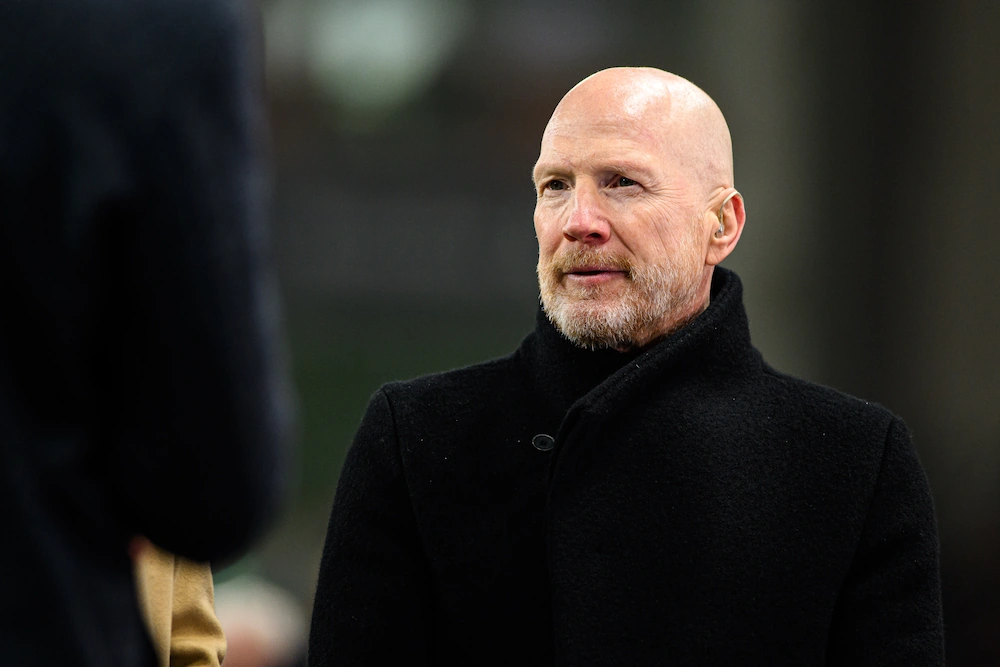
Therefore, this is a list of achievements that led to Matthias Sammer's victory regarding the Ballon d'Or in 1996.
Massive National Success
The interesting part of Matthias Sammer's massive success with Borussia Dortmund is that he wasn't a major star when he signed for the club. On the contrary, he could be considered a flop during his time with Inter Milan in Serie A during the 1992/93 season, who he had joined from Stuttgart, with the defender struggling to make a name for himself over there despite scoring 4 goals in 11 matches across all competitions.Indeed, after six months abroad, Sammer would return to his home country once more, this time to play with Dortmund. While this could be considered a failure from his end, he would become the libero and leader of a new era of the club, winning the 1994/95 and 1995/96 Bundesliga titles, something that the club didn't manage to accomplish since the 1960s.
When it comes to individual awards, he would also win Footballer of the Year in Germany in 1995 and 1996, which is something that should be praised when considering he was mostly used as a defender.
It was also during this period that he would be named Bundesliga-best libero in 1995 and 1996 by the German magazine kicker, after already receiving their Bundesliga-best midfielder reward in 1993, with the latter being even more notorious since he had just arrived from Italy.
Therefore, at a time when Borussia Dortmund was the dominant force in German football, Sammer managed to stand out, establishing himself as one of the best players in the world, and that played a role in his 1996 Ballon d'Or victory.
The 1996 Euros
Winning an international tournament is always going to be good for your profile. Now imagine doing it with Germany, and in England, of all places.That is exactly what Matthias Sammer did, playing as a libero in Berti Vogts' back-three and becoming the best player of the competition as the Germans beat Czech Republic 2-1 in the final to take home the trophy.
"Sammer was magnificent throughout this tournament, using his free role to sweep up behind Germany's other defenders, always seeming to arrive at the right time to nick the ball away from opposition forwards," notorious football writer Michael Cox said in 2024 to the New York Times when remembering Sammer's performances during this competition. "He also used his freedom to push forward into attack, popping up with the opener against Russia in the group stage. Then, in the 2-1 victory over Croatia in the quarter-final, his runs into the box brought both goals - first forcing a handball for a penalty dispatched by Jürgen Klinsmann, then later having a headed effort blocked and tucking home the rebound himself."
This victory and recognition as the best player of the competition, coupled with the aforementioned success in the Bundesliga, further established Matthias Sammer as the main candidate for the Ballon d'Or, which he would end up winning. When considering that only Fabio Cannavaro and Sammer's compatriot, Franz Beckenbauer, as of this time of writing, have been the only defenders to win the award apart from Sammer, it is a massive achievement that should be praised a lot more often.
Playing Style
Sammer possessed the playmaking skills of a traditional playmaker and the defensive strength of a center-back. Additionally, he one of the best defenders when it came down to game-reading. He showcased superb positioning and exploited spaces mercilessly, while simultaneously narrowing gaps between his team's lines during the opponent's possession.He often played as a traditional libero behind the center-backs, as a six out of possession, and sometimes even as a ten when in possession. The way he played football was extremely challenging in terms of technique, mindset, and physique, but he managed to get all of that done at the highest level.
In many ways, he was a perfect example of the German footballer during the mid-90s, which was properly reflected during his later years with Borussia Dortmund. This is something that a lot of people don't recognize, and it is the fact that Sammer retired in 1998, two years after winning the Euros and the Ballon d'Or and a year after winning the UEFA Champions League.
Therefore, the older he got, the better he performed.
"Sammer wasn't faultless," Cox said in 2024 to the New York Times. "He was partly culpable for the concession against Croatia and he conceded the penalty in the final against the Czech Republic when bringing down Karel Poborsky. The foul clearly took place outside the penalty box, but if the referee had awarded a free kick, he would probably have had to dismiss Sammer. That would have put him alongside Roberto Baggio in 1994, Ronaldo in 1998, Oliver Kahn in 2002 and Zinedine Zidane in 2006 as players who were arguably the best at a tournament, but ended it as the fall guy. But Sammer stayed on and he won both the player of the tournament award and the 1996 Ballon d'Or, pipping Ronaldo by a single point. Only he, Beckenbauer and Fabio Cannavaro have won the Ballon d'Or as a defender, although like Der Kaiser, Sammer was so much more than a mere defender."
Couldn't have said it better.