
The History of Belgrade's Eternal Derby Between Red Star and Partizan
We've already explored some of football's fiercest rivalries, including Fenerbahce vs Galatasaray in Turkey and Olympiakos vs Panathinaikos in Greece. But few derbies can match the intensity of the rivalry between Red Star Belgrade and Partizan Belgrade. Known as the Eternal Derby, their encounters are among the most passionate and fiercely contested in world football, fuelled by decades of sporting competition, political history and deeply rooted supporter traditions.
Red Star Belgrade supporters
Red Star Belgrade - From 1945 to European Glory
Serbia's history as a nation includes several changes. At one time, they were part of the now-defunct Yugoslavia, then Serbia and Montenegro, and more recently, they separated to become an independent nation. Red Star (Crvena Zvezda in Serbian) is the club with the most league titles in Yugoslavia and Serbia, as well as cups in Yugoslavia, Serbia and Montenegro, and Serbia. Not bad at all. Contrary to what one might think, Red Star isn't as "old" a club as its trophy cabinet might suggest, since it was founded in 1945, near the end of World War II.This was partly related to the political changes following World War II, when Yugoslavia's new communist authorities dissolved several pre-war football clubs, some of which were accused of collaborating with the occupying forces. Red Star was established in March 1945 by members of an anti-fascist youth organisation and inherited some of the resources of the former SK Jugoslavija. From its inception, the club had strong connections to the new communist political establishment in Yugoslavia. Over the following decades, however, Red Star would also develop a strong association with Serbian identity, particularly among sections of its supporters. With only three years of history, Red Star won its first major title, lifting the Yugoslav Cup in 1948, a feat they repeated for three consecutive seasons. After that run ended, they became Yugoslav league champions in 1951.
Throughout the 20th century, they enjoyed several periods of domestic success, which led to their regular participation in European competitions. In 1979, they reached the UEFA Cup final against Udo Lattek's Borussia Mönchengladbach, drawing the first leg 1-1 at home before losing the return leg 1-0 in West Germany. However, the true milestone came in 1991 when they won the European Cup, defeating Olympique de Marseille, featuring Jean-Pierre Papin and Abedi Pelé, on penalties. That same year they also won the Intercontinental Cup, beating Colo Colo of Chile 3-0. The Belgrade team boasted some very important names such as Sinisa Mihajlovic, Vladimir Jugovic, and Dejan Savicevic.
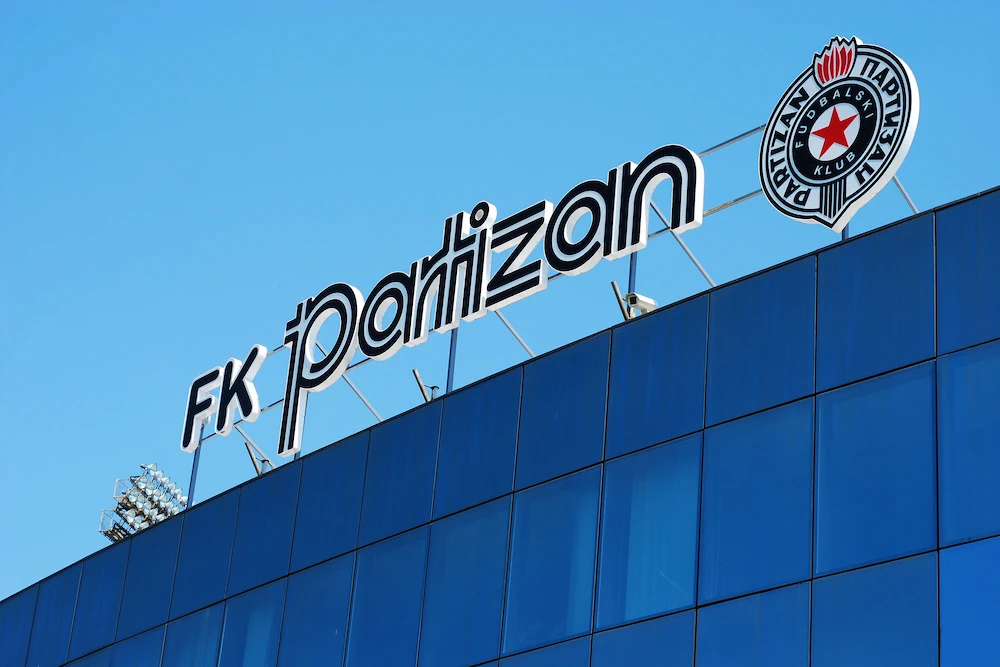
Outside Partizan stadium
Partizan Belgrade - From Army Club to European Finalists
Just a few months later, but still in 1945, FK Partizan was founded. Its name comes from the Partisans, an anti-fascist military group that fought in Yugoslavia during World War II. The club was founded on 4 October 1945 as a sports organisation associated with the Yugoslav People's Army. Interestingly, just two days after its formation, Partizan was already playing a match (a friendly, of course) against a small team from the Zemun area. In fact, until they entered the 1946-47 league, they only played friendly matches. Remarkably, in that first league season, they not only competed for the title but won it with relative ease.That season they achieved the double, also winning the cup, and a couple of years later, they repeated their league title, leaving the impression that they were going to be one of the best teams in Yugoslavia after those great early years. However, in the following decade, the club failed to win any league titles, although they did win a few Yugoslav Cups. This led the club to decide to change certain things, such as their uniform, switching from red and blue to the black and white they have used ever since.
Another important change, and possibly the most defining for Partizan's future, was their decision to focus more on young players, both from their own youth academy and talented youngsters recruited from other parts of Yugoslavia. That team won the Yugoslav league four times between 1960 and 1965; however, the true peak of this generation was reaching the 1966 European Cup final, having eliminated, among others, Matt Busby's Manchester United in the semi-finals. The only thing that prevented that team from becoming European champions was Miguel Muñoz's Real Madrid, who, as you can imagine, came back from an initial 1-0 deficit in the final to snatch the Cup from the Belgrade side with two goals in six minutes.
©
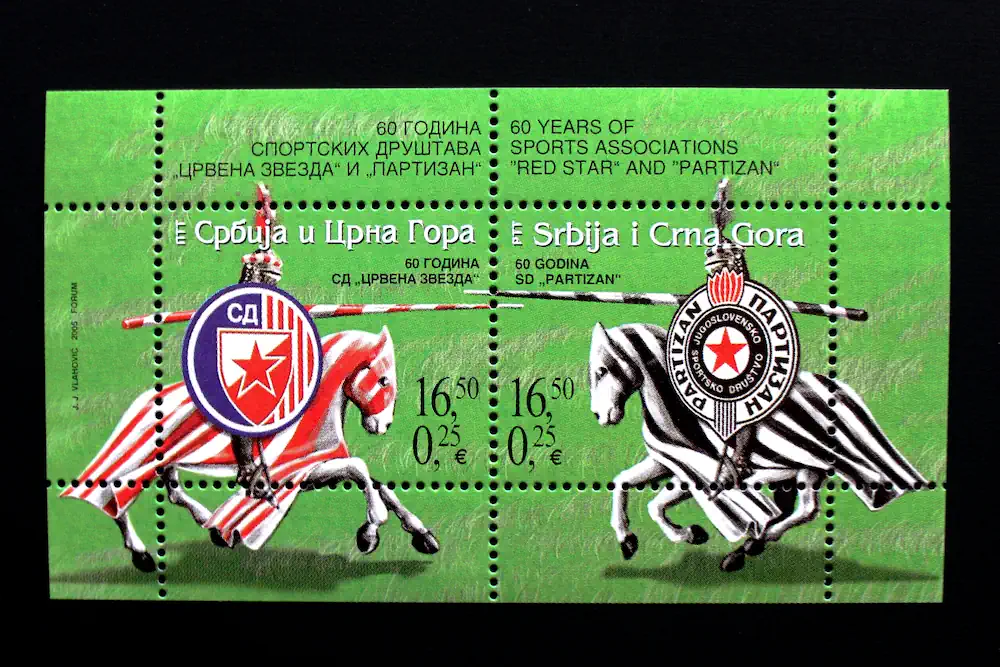
Stamp illustrating the rivalry between Red Star and Partizan
The Origins of the Eternal Derby
Although the two clubs were founded just months apart, they represented different institutions within post-war Yugoslavia. Red Star emerged from the civilian anti-fascist youth movement, while Partizan was established through the Yugoslav People's Army. These different origins, combined with their competition for supremacy in Belgrade and Yugoslav football, helped lay the foundations for an increasingly intense rivalry. Their first encounter was in 1947, with Red Star emerging victorious, defeating Partizan 4-3. This marked the beginning of a rivalry that would only intensify in the following decades. The 1966 European Cup final was, for a long time, a source of great pride for Partizan fans, who boasted about it to Red Star supporters, who, while more dominant domestically, had not achieved such success in Europe. Something that was reversed with the 1991 European Cup.The fact that both clubs also compete in other sports, especially basketball, is another factor that has helped make this rivalry one of the most intense in the world. This means that supporters of the two clubs face each other several times throughout the year, something similar to what happens with Olympiakos and Panathinaikos in Greece. Obviously, the fact that both clubs are based in Belgrade also plays an important role, since supporters of the two teams regularly come across each other in everyday life, making the rivalry something that goes well beyond the football pitch.
Delije, Grobari and the Passion of Belgrade
The fans themselves also play a huge role in making this rivalry one of the most intense in world football. Red Star's most passionate supporters are known as Delije, which roughly translates to "Heroes" or "Brave Men", while Partizan's supporters are called Grobari, meaning "Gravediggers", a nickname associated with the club's black-and-white colours. Both groups are famous for their spectacular displays in the stands, with enormous banners, coordinated chants, flares and other pyrotechnics that create an incredible atmosphere whenever the two teams meet. However, the passion sometimes goes too far, and over the years there have been numerous violent confrontations between supporters, as well as clashes with the police. For many of these fans, supporting their club is not simply about football, but something that forms an important part of their identity and everyday lives.Another factor that makes the rivalry even more special is the fact that the two clubs' stadiums are located so close to each other. Red Star play their home matches at the Rajko Mitic Stadium, commonly known as the Marakana, while Partizan play at Partizan Stadium, also historically known as the JNA Stadium. Both stadiums are situated in the same part of Belgrade, only a short distance apart, which naturally adds to the intensity of the rivalry. Red Star's stadium is the larger of the two, and its northern stand is traditionally occupied by the Delije, while Partizan's Grobari are mainly associated with the southern stand of their own stadium. When the Eternal Derby is played, regardless of which team is at home, the atmosphere is something quite extraordinary, with thousands of supporters singing, waving flags and creating a spectacle that has made this particular derby famous well beyond the borders of Serbia.
Memorable Derby Matches and Domestic Dominance
Naturally, with such a long history between the two clubs, there have been plenty of memorable matches over the years. One of the most famous was the 100th league derby, played on 6 May 1995, when Red Star defeated Partizan 2-1 in front of around 80,000 spectators at the Marakana. Partizan had taken the lead, but Darko Kovacevic equalised from the penalty spot before Mitko Stojkovski scored the winning goal late in the game, much to the delight of the home supporters. Another particularly important encounter took place in May 2013, when Partizan won 1-0 thanks to a late free kick from Milos Jojic, a victory that effectively secured them the Serbian league title. The two teams have also met in several domestic cup finals, including in 2017 and 2019, both of which Partizan won 1-0. These are just a few examples of matches that have helped build the history of the Eternal Derby, where a victory against the biggest rival can sometimes mean almost as much to the supporters as winning a trophy.The breakup of Yugoslavia in the early 1990s also brought major changes to the country's football landscape. With clubs from Croatia, Slovenia and other former Yugoslav republics no longer competing in the same league, Red Star and Partizan found themselves with even fewer challengers for domestic trophies. However, despite all these political and sporting changes, the rivalry between the two Belgrade giants remained as intense as ever. Previously, Croatian teams, primarily Dinamo Zagreb and Hajduk Split, had also been vying for Yugoslav trophies, representing the other major force in the country's football scene. In the Serbian league, they are clearly the two dominant forces to this day, a fact reflected in their domestic dominance. Since the breakup of socialist Yugoslavia, only Obilic, in the 1997/98 season, has managed to break the two Belgrade giants' dominance of the league, demonstrating their extraordinary control over Serbian football.