
The Forgotten Story of Figo's Failed Move to Italy
In today's football, with social media platforms, cellphones, etc., it seems that absolutely everything that happens to the players and teams is known. And perhaps this is not totally true, but it is a fact that much more information is known than in other times. For example, in 1995, Luis Figo would sign for FC Barcelona, starting a very good stint that would end with one of the greatest betrayals in memory when he signed for Real Madrid in 2000.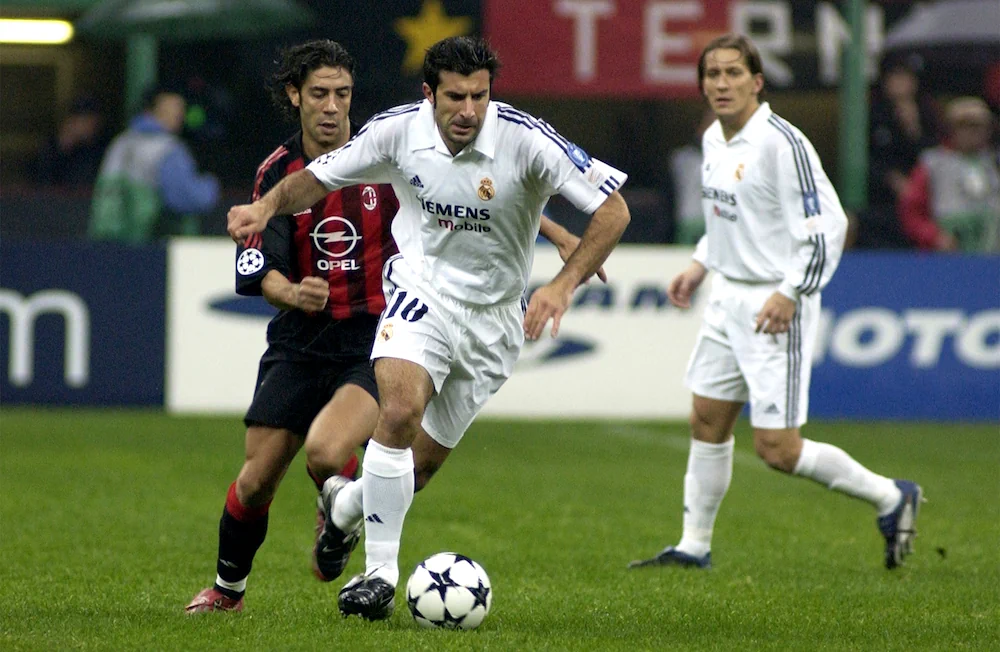
©
Luis Figo when he played for Real Madrid
The Figo of Sporting
Figo began his formation in the sport as a futsal player, although at the age of 12 he joined the youth teams of Sporting Clube de Portugal, where he was always in very good consideration both by the club itself and by the Portuguese federation, which considered him for Under-16s category. In fact, in 1989, with the Under-16s Portugal national team, Figo won the Euro in that division. For the 1989-90 season, at just 17 years old, he began training with Sporting's first team and made his professional debut.In 1991, he would win the FIFA World Youth Championship with the Under-20s Portugal national team, where people would begin to talk about the Portuguese golden generation in which Rui Costa and Jorge Costa also shined alongside Figo. Starting in the 1991-92 season, Figo would consolidate himself in Sporting's first team, curiously as a more centralized midfielder than as a winger, a position in which he would be well recognized later in his career.
The Portuguese played as an attacking midfielder with great movement, good passing ability, a lot of skill and a great long shot. Figo would spend the next few years of his career with "Leões" (The Lions), as a regular in the first team's starting elevens and as a prominent figure in Portuguese football, in addition to being called up to the Portugal national team.
At that time, unlike today, football was not so easily accessible, so scouting had to be done while being on-site, plus there was a limit on foreigners which meant that clubs had to be very selective when recruiting a player of another nationality. That is why Figo remained at Sporting for several seasons, something that would be more complicated today. To this we had to add that the Lisbon club was always in the shadow of Benfica and Porto and that Portugal did not qualify for the 1994 FIFA World Cup, so its international visibility was lower.
Juve and Parma
In September 1994, Sporting played the first round of the UEFA Cup against Real Madrid, where Los Blancos would advance despite the two-goal aggregate score due to the away goal. Figo left a great impression in Spain and, a few weeks later, Barcelona approached Sporting and the player's agent to try signing him. The answer they received was that they were late since the Portuguese club had negotiated the signing of Figo with Juventus a few days prior.A payment of the equivalent of 3.5 million euros had currently been agreed, because Figo was in the last year of his contract. The pre-agreement reached was for the young Portuguese to join the Italians in the summer of 1995. But back in February 1995, Parma, one of the most economically powerful teams of the time, knowing that the player was ending his contract in less than 6 months, skipped talking with Sporting and went directly to Figo and his agent, seeking to reach an agreement to sign him in the summer.
The player and his agent accepted Parma's offer as it was considerably better than Juventus'. At that time, an amount had to be paid to the club the player was leaving, even if his contract ended. In this case, the amount was 2.5 million euros, making the conversion. When Sporting found out about the agreement with Parma and knowing that it meant a loss of one million euros for the club, this generated problems between the player and the club.
The Resolution
When the Italian federation found out about the case, they disqualified Figo from playing in Italy for two years, which was the punishment that corresponded to cases of this type at the time. Upon learning this, Juventus, upset by how Figo and his agent acted, ended up canceling the agreement with the Lisbon club. At this point, the Portuguese player could not play in Italy for two years and had a bad relationship with Sporting, so he found himself in a kind of limbo.And it was at that point that Barcelona appeared who, in the first instance, sought to agree on a two-year loan with Parma, so that the Portuguese could go to Italy once the sanction ended. However, the Catalan club ended up reaching an agreement directly with the player, who was ending his contract, with Sporting to pay the amount for the footballer's formation and with Parma.
In the case of the agreement with the Italian club, two conditions were included: the first was that after two years, Figo could leave Barcelona to sign for Parma if that was the player's wish and second, the Italian club was left with a preferential option for Hristo Stoichkov, which they ended up using in that same summer of 1995. This is how, after a season full of comings and goings, Figo changed his destination, which seemed to be Italian, to reach Catalonia. The rest of Figo's story is a little better known.