
Sir Alex Ferguson's Scottish Years Before Manchester United
Sir Alex Ferguson became the world's greatest-ever football manager during hiss many decades coaching Manchester United, but the reality is that the Scotsman didn't start there. After retiring from professional football in the early 70s, the then-forward would begin his career in coaching in his home country of Scotland, where he would begin to make a name for himself.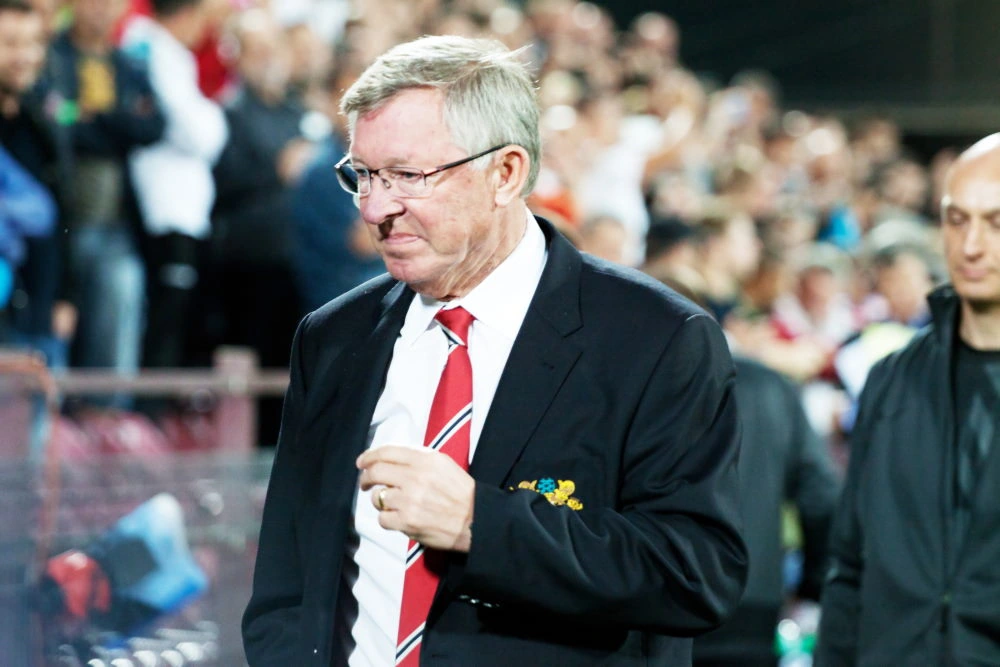
It Started at East Stirlingshire
It was in East Stirlingshire it all started but this club is mostly treated as a footnote in Ferguson's career, but that is where all began for him as a manager. He was there solely one year, 1974, and had to deal with a lot of situations, including the lack of players to make up a starting eleven."I have had 39 years as a manager," Ferguson recalled about his time at East Stirlingshire in 2013. "On that day in 1974, when I started at East Stirling, I had eight players and no goalkeeper. Today I have six goalkeepers and about 100 players."
"I remember the old chairman Willie Muirhead, he was a great chain smoker. When I asked him for a list of players, he started to shake. His cigarette was going 100 miles an hour. I had to remind him a couple of days later. He gave me a list of eight players and no goalkeeper. I said 'you know it is advisable to start with a keeper, are you aware of that?'."
Despite that, the then-young manager was beginning to build his reputation of a disciplinarian, which is something that played a huge role in his values for the next few projects he would take on.
Next Stop St. Mirren
Ferguson coached St. Mirren from 1974 until 1978. They were a bigger club than his previous one, but they were on a lower position in the league, although the Scotsman would slowly turn things around. He would develop young players and even go as far as having the club win the league in the second tier of Scottish football, the First Division, in 1977, with a squad that had an average of 19.There have been a lot of reports and discussions surrounding Ferguson's sacking in 1978. After all, this is the only time in his entire career that he was sacked, which makes this situation even more notorious.
There were claims of contract breaches, not paying certain players, issues with some staff members, but Ferguson has dismissed all of that. There were even reports that he had agreed to join Aberdeen and that was the reason for his sacking.
"I think most St Mirren supporters would agree he is the best manager we have ever had," says John Byrne, a former historian of the club, to The Guardian in 2003 regarding the sacking of Ferguson. "I can remember walking through the town and seeing the Paisley Daily Express ('Saints Shocker' cried the front page). It was a bombshell to everyone. There had been no warning and the fans were just stunned."
This resulted on a trial that would last four day and a series of grievances that the club would hold against him, including things such as money pinching. However, the manager, despite feeling frustrated by the results of the trial, already had a new job in store with Aberdeen and was looking forward to the experience.
"How stupid I was to pursue the matter," Ferguson, then 36, said at the time, as per The Guardian. "I had felt degraded by being sacked. After everything I had done for them, I was obsessed with getting revenge. I wanted to humiliate them in the way they had humiliated me."
As it tends to happen with Ferguson, his legacy as a manager would remain as the biggest element in his tenure with this club.
"For all the talk of financial irregularities, and Ferguson was clearly a hard man to work with, the bottom line was that we lost a very good manager," says Alistair McLoughlin, a lifelong fan and the club's programme editor. "(He) used to go down the main street in Paisley on Friday afternoons with a loudhailer, urging the shoppers to support their local team. He was very popular. He'd got us into the top league, which we hadn't done for some while, and a lot of people thought we had found the messiah for further success. So you can imagine the disappointment when it all blew up."
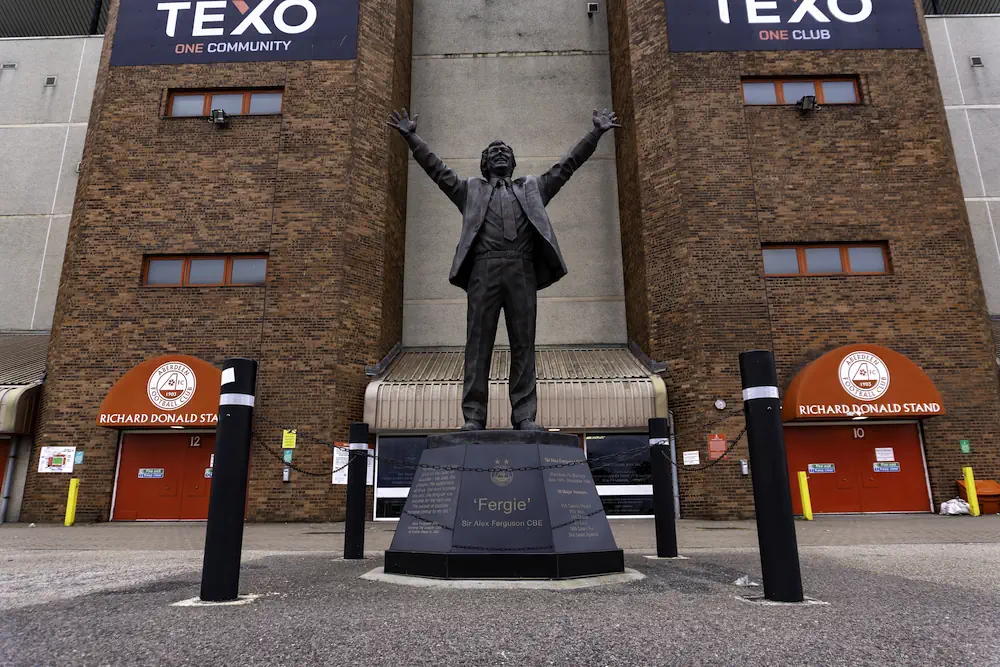
Sir Alex Ferguson statue outside Aberdeen's Pittodrie Stadium
His Legendary Time at Aberdeen
Ferguson's time with Aberdeen is legendary. From 1978 to 1986, he built a dynasty that won the top-flight league division three times with a team that is Celtic or Rangers. As of this writing, no other team has won the league ever since, which is saying a lot. Coupled with the fact that he won several cups and did so while playing good football and developing young talent, it is easy to see how he was a star manager on the rise.Furthermore, his biggest accomplishment was winning the 1982-83 European Cup Winners' Cup against European giants, Real Madrid.
An interesting strategy that Ferguson did before the match was gifting then-Real Madrid manager Alfredo Di Stefano, who was also a club legend and one of the all-time greats of the sport, a bottle of malt since he heard from Jock Stein, the former Celtic and Scotland manager that Ferguson looked up to, that the Argentinian was a fan of that. However, Madrid's coach didn't have anything to offer to him.
This was Ferguson's way to get them into a false sense of security before the final.
"He'll think you are just here to enjoy the moment," then-Aberdeen captain Willie Miller said of what Ferguson was told about Di Stefano in 2024. "And then go into your dressing room and tell your players that these opponents just think you are here to make up the numbers.'"
It was a brilliant that would prove, once again, that Ferguson was meant for greatness as a manager. And once he joined Manchester United, that would be reality.