
Real Madrid's Forgotten Season of Five Runner Up Finishes
When we talk about teams that usually finish as runners-up maybe the last one that comes to mind is Real Madrid, but, although it may seem hard to believe, the Madrid team had a season that will always be remembered by the club's fans as the one with five runner-up finishes.
A little context
Real Madrid has always been an important team in Spain, but it was with the arrival of Alfredo Di Stefano in the 1950s that the club gained another dimension, especially internationally. They not only dominated Spanish football but, with the creation of the European Cup in 1955, they also dominated the new international competition, winning the first five editions. In fact, generally speaking, from the mid-1950s until the 1970s, Real Madrid was the leading power in Spain and, during certain periods, in Europe. Naturally, that generation led by Di Stefano, which included greats like Puskás and Gento, gradually gave way to new players who maintained the high standard.Besides changing the names of the players, the tenants who occupied the bench were changing (something relatively common in Real Madrid, which does not usually have managers who last a long time in the position) but above all, in 1978, it suffered the physical loss of its president, Santiago Bernabeu, architect of that great Real Madrid that had dominated for almost two decades. In the 1981-82 season, the manager of Real Madrid was the Yugoslavian Vujadin Boskov, but near the end of the season, he was replaced by Luis Molowny, who had already won titles as both a player and manager for Real Madrid. That season ended with a disappointing third place in the league, although they did win the Copa del Rey, reaching the final just a couple of weeks after Molowny's arrival.
1982-83 La Liga and Spanish Supercup
The club decided not to continue with Molowny and opted for Di Stefano as manager, who had a successful coaching career in both Argentina and Spain, having won titles in both countries. The signings weren't particularly exciting, with Dutch defender John Metgod being the most notable; in fact, most of the reinforcements were for the defense. The club placed its faith in the players already on the team, such as Camacho, Stielike, Del Bosque, Gallego, Santillana, and Juanito. Although several of them had arguably already given their best performances for Real Madrid, something that would become apparent over time.The first title at stake was the Spanish Super Cup against Real Sociedad, the league champions. In the first leg, Real Madrid won 1-0. In the second leg, the Basque team tied the aggregate score, forcing extra time, where they triumphed by scoring 3 goals, leaving the final aggregate score at 4-1.
In the league, Real Madrid led for much of the season, going into the final matchday in that position, their fate in their own hands. They faced Valencia, who needed a win to avoid relegation, while their closest rival, Athletic Club, played Las Palmas, who were also in the relegation zone. Real Madrid lost 1-0 to Valencia, who secured their place in the top flight, while Athletic Club thrashed Las Palmas 5-1 to clinch the title, relegating them in the process.
Copa del Rey
In the Copa del Rey competition, the journey began in the Round of 16 against Cádiz, with a 0-0 draw in the first leg, although Real Madrid managed to win the return leg 4-1. They then overcame Sevilla 4-1 on aggregate and Sporting Gijon 6-4 in the semifinals, with a bit of tension at the end as the Madrid team won the first leg 6-0 and Sporting had started a comeback in the return leg that ultimately fell short. In the final, their arch-rivals, Barcelona, awaited.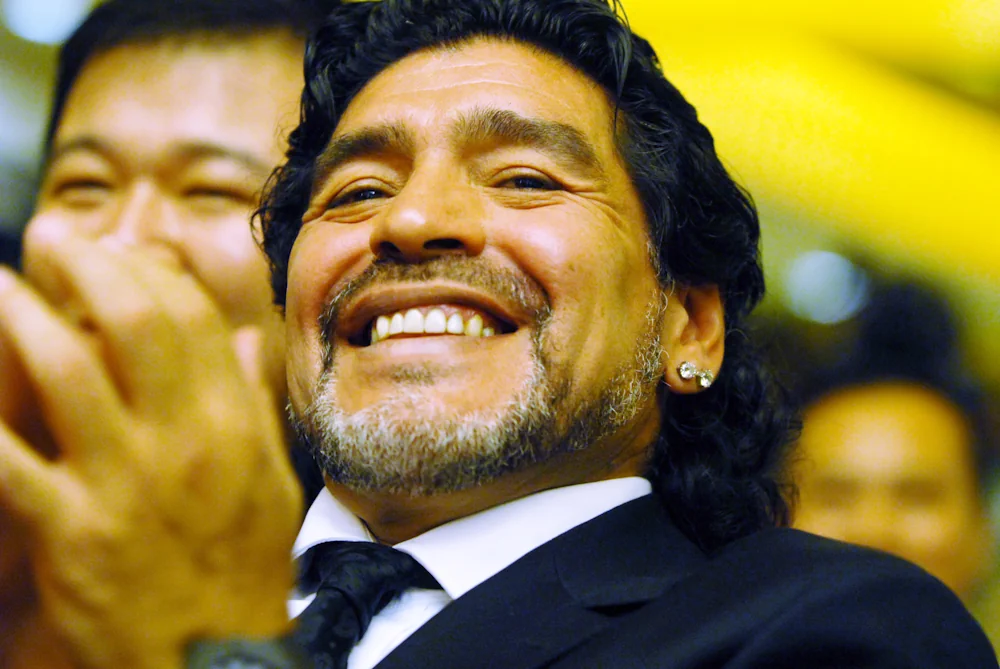
Maradona was part of the Barcelona team that killed Real Madrid's title dreams that time
Copa de la Liga
The Copa de la Liga was a tournament played in Spain for four seasons, beginning in the 1982-83 season and ending in 1986. It was largely promoted by the president of Barcelona, Josep Lluís Núñez. Real Madrid started in the quarterfinals, defeating Real Sociedad. Then, in a thrilling semifinal, Real Zaragoza beat Real Madrid 5-3 in the first leg, but Di Stéfano's team leveled the tie with a 5-3 victory in the second leg, and the match was decided by penalties (5-4 in favor of Real Madrid). The final, this time a two-legged affair, was again against Barcelona. The first leg ended in a 2-2 draw at the Santiago Bernabéu stadium, but the second leg was a 2-1 victory for the Catalans, who had Maradona on the scoresheet in both matches.European Cup Winners' Cup
As the winner of the 1981-82 Copa del Rey, Real Madrid entered the third-tier European competition at the time, the Cup Winners' Cup. The team remained undefeated until the final, overcoming Baia Mare of Romania in the first round, Újpest of Hungary in the round of 16, Inter Milan in the quarterfinals, and Austria Vienna in the semifinals.Their opponent in the final was Aberdeen of Scotland, then managed by Sir Alex Ferguson (who was not yet a Sir at that point), and the match was played in Gothenburg, Sweden. It was another closely contested final, which ended in a 1-1 draw after 90 minutes, with goals from Eric Black and Juanito. But, to Real Madrid's misfortune, in the 112th minute, John Hewitt, who had come on as a substitute to replace Black, scored the historic goal that gave Aberdeen their first European title in history and left the Spanish team with a fifth runner-up finish for the season.
Despite this disappointing and historic (in the bad sense) season for Real Madrid, it caused changes in the club that led to several academy players being promoted to the first team, such as Emilio Butragueño, Miguel Pardeza, Manolo Sanchis, Michel Gonzalez, and Martin Vazquez, who would form the famous La Quinta del Buitre, which brought much joy to the club in the following years.