
Otto Rehhagel's Legacy of Shock Victories
There is something in human nature that makes you want to support the underdog, perhaps because of the representation of personal improvement or simply because of how great a story can be that may seem more like a movie than real life. Because it is not very common, when it does occur, it is usually a significant event that draws the world's attention.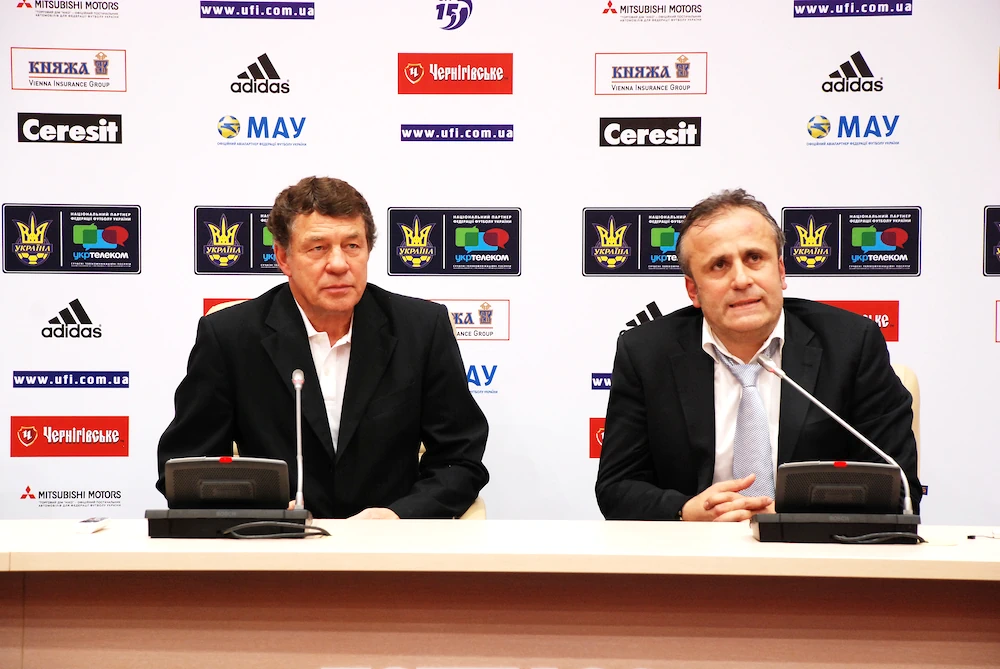
©
Otto Rehhagel(to the left) at a press conference
Beginnings
Otto Rehhagel was born in Essen, Germany, on August 9, 1938 and although he is German by birth, it can also be said that he is Greek by adoption. Rehhagel had a good career as a football player, specifically as a defender (a very strong one, in fact), playing more than 200 Bundesliga games when this competition was starting, mainly with Kaiserslautern and Hertha Berlin.Almost immediately after retiring in 1972 as a professional football player, he began his long journey in the dugout, starting in modest Rockenhausen. Without much success, he then moved to Saarbrucken from where he decided to take a small detour in his career, taking over as assistant manager of Kickers Offenbach. Only a year later, he would be the manager of the team, which at that time was in the Bundesliga.
In 1976, after Werder Bremen had a disappointing first half of the season with Herbert Burdenski on the bench, they decided to bet on Rehhagel, who would only remain in office for about 4 months but who demonstrated his ability to coach in the German first tier. An important team like Borussia Dortmund, which had come from a lackluster five years, hired him and he stayed there for a couple of years. What solidified his departure from Dortmund was a historic 12-0 defeat against the other Borussia club, Mönchengladbach.
A year later he would pass through Arminia Bielefeld before arriving at Fortuna Düsseldorf. The Flingeraner (which is the nickname for Fortuna Düsseldorf) came from being runner-up and champion of the DFB Pokal, in the previous two seasons, respectively. Otto rose to the occasion and won the cup again, in what would be his first title in professional football, including his time as a player. Funny enough, in the quarterfinals, Fortuna Düsseldorf defeated Kickers Offenbach and Borussia Dortmund in the semifinals, two of Rehhagel's former clubs.
Werder Bremen
Once again, Bremen saw Rehhagel as having the potential to be the one to lead the club and this time the bet would be greatly rewarded. King Otto arrived at a Werder Bremen that was a candidate to be relegated in the Bundesliga and a team that was not a great opposition for rivals. He quickly turned it into a solid team with good defense and great attacking energy using the pace of his players to develop counterattacks.His time in Bremen would last 14 years, obtaining 7 trophies, including two Bundesliga titles and a UEFA Cup Winners' Cup, for what would be the most successful period in the club's history. In addition, he promoted important big German players such as Rudi Völler, Karl-Heinz Riedle or Mario Basler. Rehhagel is the second longest-serving coach at a Bundesliga club, only surpassed by Volker Finke, who spent 16 years on the Freiburg bench.
©
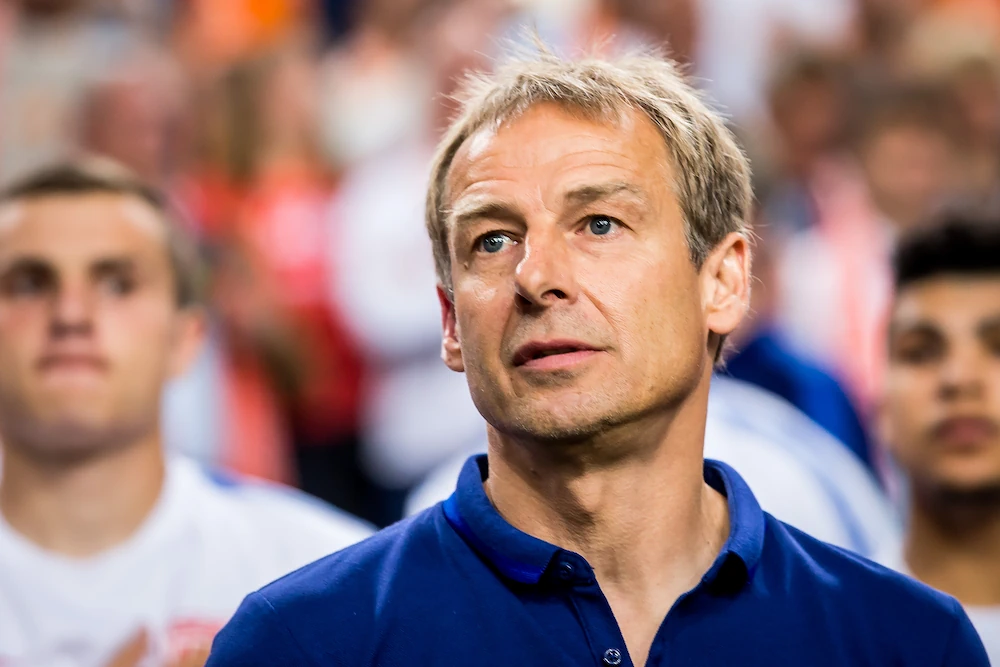
Jürgen Klinsmann was signed by Bayern Munich when Rehhagel arrived
FC Hollywood
Rehhagel and Werder Bremen had become a tough competitor for Bayern Munich in Germany and that was why for the 1995-96 season, they went to hire the coach. That summer transfer window, Bayern signed, in addition to Rehhagel, Thomas Strunz, Emil Kostadinov, Andreas Herzog (from Werder Bremen) and Jürgen Klinsmann, the star of the Germany national team.Despite all this and a very good start to the season, Rehhagel's methods and personality were not liked by some Bayern players who, at that time, were more similar to a group of movie stars than a football club. The coach was fired just a few days before playing in the UEFA Cup final that the Bavarian team would win with Franz Beckenbauer on the bench.
Kaiserslautern
The following season, the Essen coach went from the most important club in Germany to a club that had just been relegated to the German second tier. Far from losing motivation, Rehhagel formed an energetic team that managed to win the second division comfortably, returning only a year later to the Bundesliga. With what was demonstrated in his first season with Kaiserslautern, Rehhagel appeared to be a threat to Bundesliga teams, however, what most did not expect was that Die roten Teufel would manage to lift the title.After a great clash against Bayern Munich throughout the year, Kaiserslautern, which had become very strong in its stadium, was crowned champion of Germany, for the fourth time in its history and the second and last time to date of the Bundesliga. The team led by Rehhagel is also the only club recently promoted to the Bundesliga to be champions of the league championship. The following year, they would reach the quarterfinals of the UEFA Champions League, another important feat in the club's history.
Some conflicts within the institution led Rehhagel to resign from his position in 2000, after four great years at Kaiserslautern.
Greece
In 2001, he took over coaching duties of the Greece national team, where he had an irregular start to the final part of the qualification for the 2002 FIFA World Cup, which led him to make several changes to the team that allowed him to qualify by second time in its history to a Euro (the previous one was in 1980), the one in 2004 that was played in Portugal. In the group stage, he faced the local national team (which they defeated), Spain and Russia, finishing in second place in the group.In the quarterfinals they faced the powerful France, whom they beat 1-0 with a solitary goal from Angelos Charisteas. In the semifinals, they beat the Czech Republic of Pavel Nedved and Milan Baros also 1-0, in this case with a golden goal in the 105th minute by Traianos Dellas.
In the final, Portugal was waiting, as at home, they were the big favorites in addition to having Luis Figo, Rui Costa and a young Cristiano Ronaldo. Unfortunately for the Portugal side, Greece beat them 1-0 again, with that marvelous header from Charisteas. In this way, breaking all odds, Otto Rehhagel led Greece to its first and only Euro, something regarded as one of the biggest upsets in international football.
Rehhagel's successful, and perhaps surprising, career would close with a brief spell at Hertha Berlin in 2012 that would not overshadow what was a career full of surprising successes that would remain in the fans' memories for many years.