
When Athletic Bilbao Captivated the World Under Marcelo Bielsa
There are combinations that at first glance don't make much sense and don't leave a feeling that they could fit together. However, in some cases, everything ends up fitting together very well, producing a result that is as good as it is surprising. Back in 2011, in Spanish football, where Guardiola's Barcelona and Mourinho's Real Madrid dominated, a team emerged that, while it was like a shooting star, shining only for a short time, left very fond memories among football fans.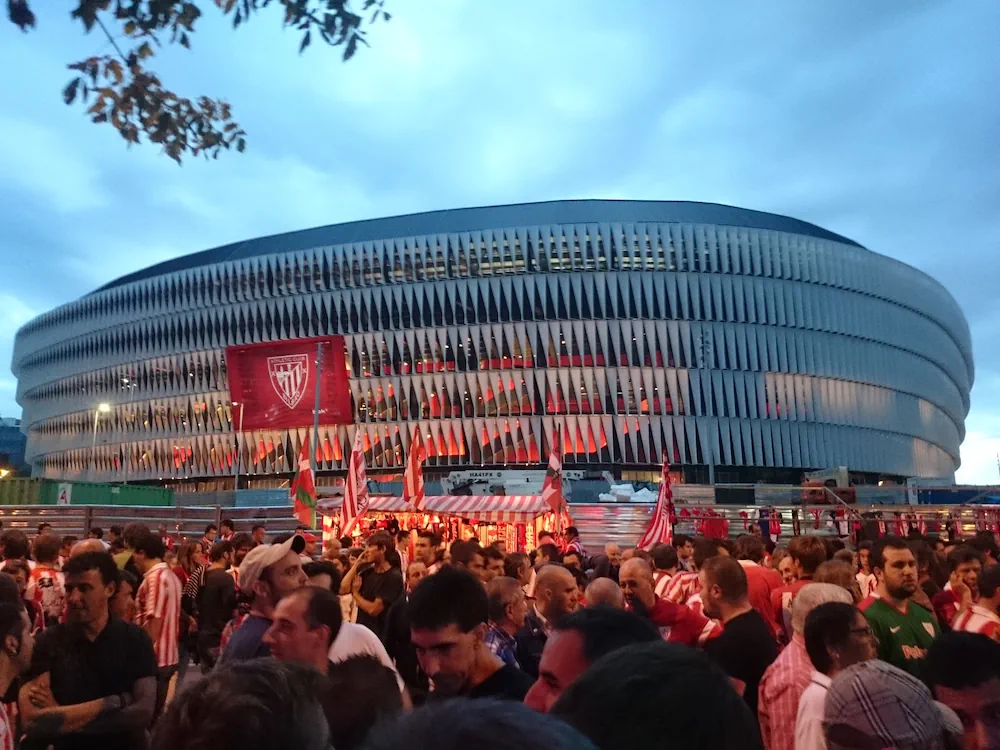
©
Athletic Bilbao fans with Estadio San Mamés in the background
A Brief Summary of Athletic's History
At the end of the 19th century, Bilbao was an industrial area, and this brought many British immigrants to the region, bringing with them a strong passion for football. Similarly, many Basques had gone to England to study and there, they also developed a passion for the sport, which they brought back to their homeland.Since 1898, several students returning from England began playing football in the area and in 1902 they decided to become an official football club. The British influence was such that the name they took was Athletic Club, with English spelling. Since 1911, the club has had a policy of only playing with Basques, which further underlines its eight Spanish league titles and 24 Copa del Rey wins. This policy does not apply to the manager and staff, so they do allow foreign coaches.
©
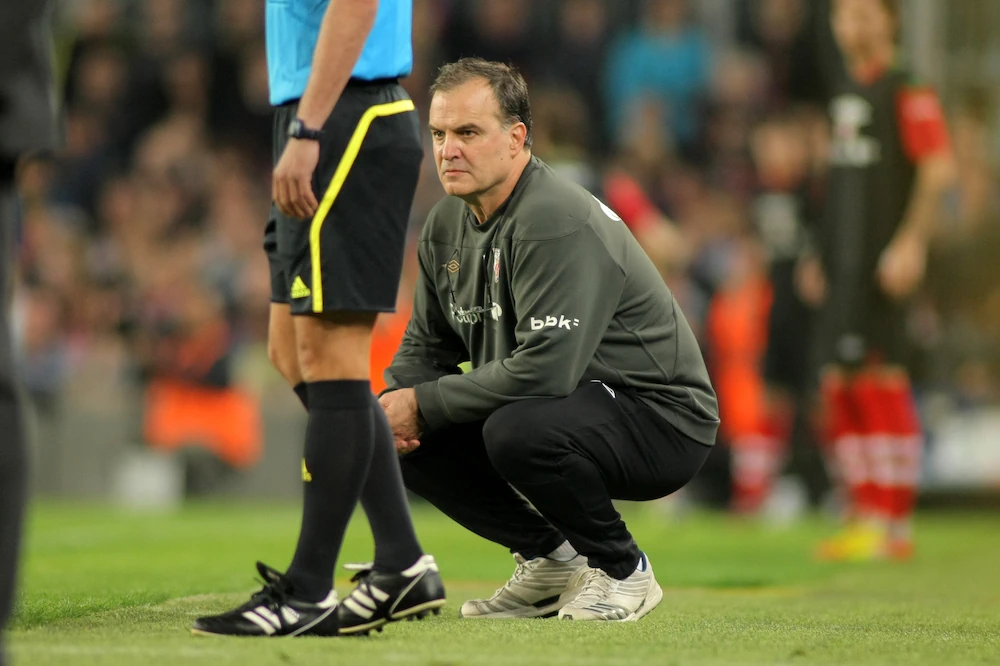
Marcelo Bielsa
Marcelo Bielsa
The Argentine was a low-profile player, but as a coach, he made a name for himself in his country's football after successful seasons with Newell's Old Boys. After a stint in Mexico, he returned to Argentina to coach Vélez, where he also did well. He later joined Espanyol for a short time after receiving a call from the Argentina national team. While he had a great generation of talent, his poor performance in the 2002 FIFA World Cup severely affected his image in his home country. In 2007, he joined the Chile national team, helping them become one of the best teams in South America. This led Athletic Club to sign him in 2011, after Josu Urrutia became president and to replace Joaquin Caparros. Throughout his career, El Loco has become famous for his fast-paced, intense, and offensive style of play, but also for his unique personality that leaves no one indifferent.2011-12 Athletic Squad
Due to the Basque club's transfer policy, their transfer windows don't usually have many new players arriving to the club, and these who do don't usually involve huge outlays. That summer of 2011 was no exception, as the only signing was Ander Herrera, who arrived from Zaragoza for around 7.5 million euros. With no new players leaving the first team, Bielsa took over a club that had been performing well in the league (finishing sixth and qualifying for Europe) and was eliminated in the round of 16 of the Copa del Rey.The squad was an interesting mix, with young, promising players and more experienced ones. Bielsa has always been a manager unafraid to take advantage of young or lesser-known players as long as they meet the demands of his system. In this sense, the Argentine manager heavily relied on a group of young players such as Iker Munian, Mikel San José, Ander Iturraspe, Oscar De Marcos, Javi Martinez (who, despite his youth, had already enjoyed a lot of playing time at the club in previous seasons), Markel Susaeta, and the newcomer, Ander Herrera. Several of them enjoyed great careers at Athletic Club, and some even became recent club icons.
This group of young players was joined by more "veterans" such as Gaizka Toquero, Andoni Iraola, David Lopez, Gorka Iraizoz, and the top scorer, Fernando Llorente. The combination of these different levels of experience and a relatively large squad with very similar performances, especially considering they were playing in three competitions, something that is not very common at the club, and that only one signing was made. The more traditional style of play in Basque football is closer to the classic style associated with the English. Route one, a lot of aerial play, a lot of aggression, elements that don't fit with what Bielsa usually uses in his teams. Thus, the team developed a passing game, lots of speed and pressure on the opponent, in addition to a very dangerous play on the wings.
Results
In the league, the team had a poor first few matches, which meant their reaction, especially in the middle of the season, did not allow them to overcome their tenth-place finish, following a drop in performance in the final stretch. In the Copa del Rey, they reached the final where they faced Guardiola's Barcelona, losing 3-0 with goals from Messi and Pedro. Finally, in the UEFA Euro League, which they started in the play-off round, they also reached the final, defeating teams like Paris Saint-Germain, Manchester United, Sporting, and Schalke 04. The final was against an old acquaintance, Atlético Madrid, where they also lost 3-0, with a brace from Colombian Radamel Falcao.As you can see, if you only look at the results themselves, the season wouldn't seem like a remarkable one. However, Athletic isn't a team that usually reaches finals, especially in European competitions. What stands out this year, above all, is the style of play that became so enjoyable for both the club's fans and neutral supporters. Bielsa's style of play often has a drawback: he demands a lot of physical demands from his players, and this season was a clear example of that. First, the initial adaptation that led to the loss of important points in the league, and then the fatigue in the final half that led to the two final losses.
Despite these shortcomings, the season left a deep impression on everyone who witnessed it. Athletic played with an identity that was unmistakably their own - bold, intense, and true to Bielsa's principles - and it was above all their journey through Europe that became the most memorable part of that season. The victories over giants like Manchester United and PSG were no coincidences; they were the result of a team that, when it reached its peak, played perhaps the most dynamic and daring football seen on the continent that year.
Sure, there were no trophies to celebrate from that season, but the emotional significance of it is something that remains in people's memories. For many supporters, it represented a rare moment when Athletic Bilbao not only competed with heart but did so with a style of play that inspired admiration across the world. Bielsa's project may have burned brightly for a relatively short period, but its legacy continues to influence how the club - and its fans - imagine what is possible.