
The End of an Era: Hamburger SV's Descent into the Second Division
Even the biggest clubs have blemishes on their rich histories; sometimes they're just bad seasons or a historic defeat. But there are cases like Hamburger SV, who, after a lifetime in Germany's top flight, were relegated in 2018, marking a turning point in the club's history and in German football.
A Bit of History
The club's founding date is not entirely clear, as two dates can be considered. One is 1919, the year the club was formed as it is known today, emerging from the merger of three football clubs: SC Germania, Hamburger FC, and FC Falke Eppendorf. The second is September 1887, the founding date of Germania (whose full name was Sport-Club Germania Hamburg), the oldest of the three clubs that would form Hamburger SV. Here, another aspect is worth noting: in 1887, Germania was established as a sports club but did not include football, which was introduced in 1891 when, as happened in many parts of the world, English immigrants brought the sport to Hamburg.Since the merger of the three clubs, Hamburger SV remained in the top tier of German football (regardless of the various transformations and stages of the German league) and consistently became one of the tournament's main contenders. In fact, they were crowned German champions for the first time in 1923, just four years after the merger. Their lowest finish had been eleventh place in the 1953-54 Oberliga Nord, but they had been very dominant at the regional level and highly competitive nationally. Arguably the club's greatest period in history was the late 1970s and early 1980s, when they won the Bundesliga three times (in addition to three runner-up finishes) and won their first international titles.
The first was the 1976-77 European Cup Winners' Cup, in which they defeated Anderlecht 2-0 in the final in Amsterdam. In 1980, they reached the European Cup final but were defeated by Brian Clough's Nottingham Forest with a lone goal from John Robertson. Football, like life, often offers a chance for revenge, and Hamburger had theirs in 1983. Under the guidance of legendary manager Ernst Happel, and with Felix Magath leading the charge on the pitch and scoring the winning goal, they defeated Juventus, featuring Michel Platini, Dino Zoff, Paolo Rossi, and Polish Zbigniew Boniek, 1-0.
From the late 90s until the mid-2010s, the club entered a period of relative obscurity as they were very inconsistent and their seasons fluctuated around the middle of the table with aspirations of entering European competitions, far from relegation but not very close to the Bundesliga title either.
When Time Stood Still
Between 2014 and 2017, Hamburger SV flirted with relegation, even forced to play relegation playoffs on a couple of occasions, which foreshadowed what could happen if they didn't turn things around. The team had developed a habit of staging comebacks in the final weeks of the Bundesliga season and narrowly avoiding relegation, sometimes in dramatic fashion.In the 2017-18 season, manager Markus Gisdol was retained after saving the team the previous season. The start of the season was good, with two wins against Köln and Augsburg, but the team quickly entered a marked decline, managing only one point in the next eight games and placing them in the relegation zone. In fact, from matchday 6 until the end of the season, their highest position was 15th, the last one outside the relegation zone.
At the end of January 2018, Gisdol was dismissed and replaced with Bernd Hollerbach, who hadn't had a particularly successful managerial career but had played eight seasons as a footballer for Hamburger SV. The idea was to bring in someone who knew the club, identified with it, and who, as a player, had always been associated with dedication and sacrifice. The new manager seemed to have a small positive effect, as his first two Bundesliga matches resulted in draws against RB Leipzig and Hannover, after a run of four consecutive defeats. However, the schedule wasn't on Hollerbach's side, as the following matches were against Borussia Dortmund, Bayer Leverkusen, and Werder Bremen, all of which ended in losses.
Next came a 0-0 draw with Mainz before a visit to the Allianz Arena to play the giant Bayern Munich. The match ended 6-0 in favor of the Bavarians, with a hat-trick from Lewandowski, a brace from Franck Ribéry, and another goal from Arjen Robben. Two days after the thrashing, Hollerbach was sacked and Christian Titz was promoted to take his place. Titz had previously been the manager of Hamburger's reserve team. Under Titz's leadership, and as in previous seasons, the team's performance improved considerably, accumulating a record of three losses, one draw, and four wins in eight Bundesliga matches.
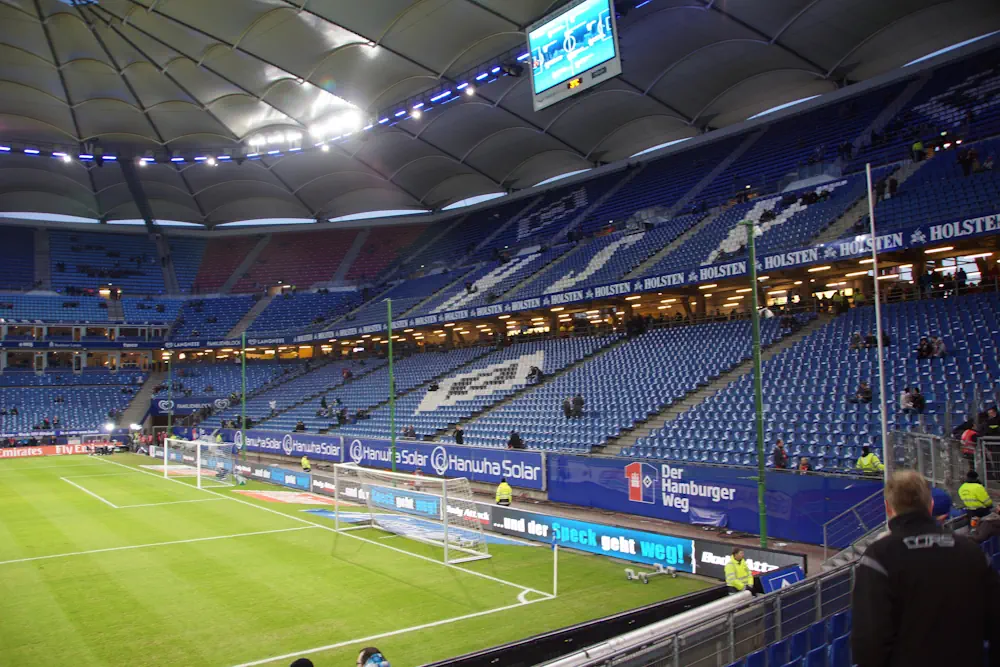
Hamburg SV's home stadium Volksparkstadion
In the Volksparkstadion there is a clock that kept track of the time the club had been in the Bundesliga (since the national competition began under this name) and on that day, the clock stopped at 54 years, 261, 36 minutes and 2 seconds later, marking the exact time they had been in the top tier of German football. The club had played in all 55 seasons of the Bundesliga up to that point, which was a source of pride for the club and the fans.
For the following season, there were many departures and also many new players, and of course the intension was to return to the Bundesliga immediately. However, they finished fourth, just one spot away from playoff. In fact, that was the position they held for their first three seasons in Bundesliga 2.
The next two seasons they finished third and reached playoff, but while they had managed to stay in the top tier for several seasons thanks to the playoffs, fate had other plans, preventing them from achieving promotion on either occasion.
It wasn't until the season of 2024-25, under the guidance of Merlin Polzin, that they finally achieved their long-awaited return, finishing second in the second tier.