
Just Fontaine's Unbeatable Goal Record from the 1958 World Cup
Just Fontaine's 1958 World Cup is still the greatest individual goalscoring performance in the history of the tournament. At this World Cup in Sweden, the French striker scored as many as 13 goals, and he did so in only six matches. This fantastic achievement is the record for most goals by one player in a single World Cup, and the record still stands. What makes the performance even more remarkable is that Fontaine played in only one World Cup finals tournament during his career, yet still left Sweden with a record that many world-class strikers have failed to beat over the years.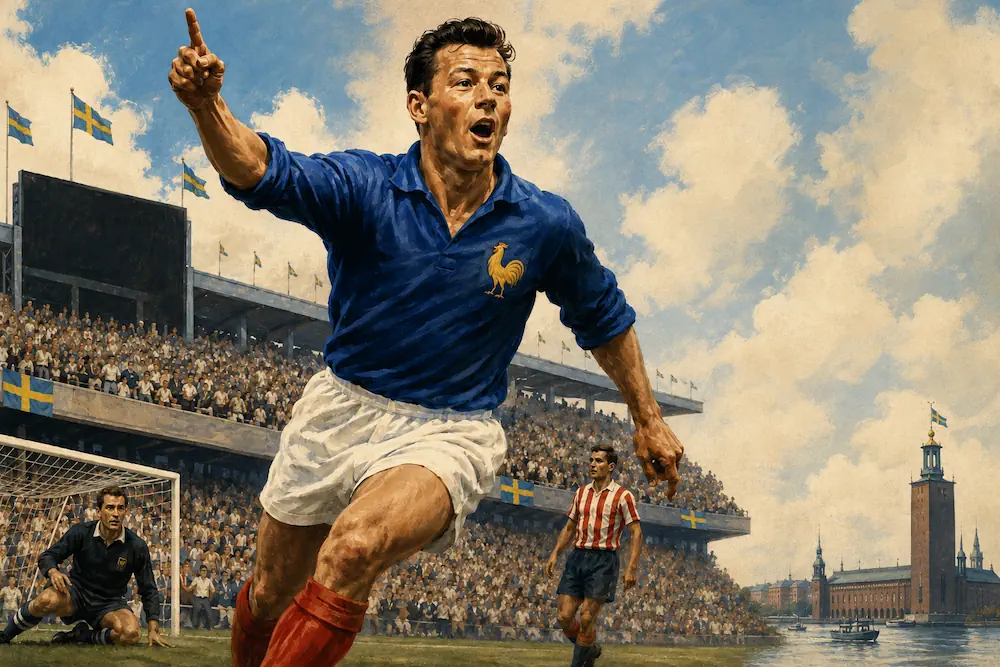
We will now take a closer look at all of France's matches and the goals Fontaine scored in them.
France vs Paraguay - 7-3
Fontaine made a flying start in France's opening match with a hat-trick against Paraguay on 8 June 1958. It was a chaotic, open and high-scoring match in Norrköping, and France's attack immediately looked like one of the most dangerous in the tournament. France won the match 7-3 and Fontaine scored three of the seven goals, giving him a place near the top of the goalscoring chart already after the first round of matches. His goals in the match came in the 24th, 30th and 67th minutes.The match set the tone for Fontaine's tournament. He was not just a penalty-box poacher waiting for one specific type of chance. He was quick, direct, strong in his movement and clinical when France transitioned forward. With Kopa's game intelligence and control behind him, Fontaine had the perfect foundation for getting goalscoring chances. Paraguay were no easy opponent, and would later draw 3-3 with Yugoslavia among other results, but France's attack overwhelmed them.
France vs Yugoslavia - 2-3
France's second group-stage match, against Yugoslavia on 11 June, became their only defeat of the group stage. Fontaine scored twice, but France still lost 3-2 in Västerås. He gave France an early lead after only four minutes and once again showed how quickly he could punish a defence. Yugoslavia fought their way back, and when Fontaine scored again late in the match, it looked as though he might have rescued a point for France. But Yugoslavia struck back almost immediately and won 3-2.Even in defeat, Fontaine's importance was obvious. France had scored nine goals in two matches, and he had scored five of them. His second goal against Yugoslavia was particularly important in the story of his tournament, because it showed that his record was not built only on one explosive match against Paraguay. He scored in different match situations: when France were dominant, when they were chasing the game and when the opponents were strong enough to push them back.
France vs Scotland - 2-1
France needed a good result against Scotland in their final group-stage match to advance, a match that was played in Örebro on 15 June. This was a tighter and more physical match than the opening game against Paraguay, and France eventually won 2-1. Kopa scored from the penalty spot and Fontaine added France's second goal shortly before half-time. Scotland pulled one back through Sammy Baird in the second half, but France held on. The result meant that France won their group. They had the same number of points as Yugoslavia, but were placed ahead of them thanks to a better goal average, which was used to separate teams on the same number of points in this tournament.Fontaine's goal against Scotland took him to six goals in the group stage. That alone would have been enough to win the Golden Boot at several World Cups, but for Fontaine it was only the halfway point. The Scotland match also underlined the value of his consistency. He had now scored against all three group opponents: three against Paraguay, two against Yugoslavia and one against Scotland. France had scored 11 goals in the group, and Fontaine had accounted for more than half of them himself.
France vs Northern Ireland - 4-0
France's quarter-final against Northern Ireland was played in Norrköping on 19 June. Northern Ireland had already had a fine tournament by reaching the last eight, but their story ended in the quarter-final as France were too strong. The French won 4-0, and this time Fontaine scored two of the goals. Maryan Wisniewski opened the scoring, but Fontaine then scored twice in the second half and France moved comfortably into the semi-finals.By this point, Fontaine had scored eight goals in four matches. His partnership with the rest of the French attack was working excellently. Kopa's creativity, Piantoni's movement and France's willingness to attack gave Fontaine chances, but his finishing made the difference between a good team and a devastatingly strong one. The match against Northern Ireland also showed that France were not just entertaining; they were beginning to look like serious contenders to win the tournament. A 4-0 win in a World Cup quarter-final is a powerful statement, and Fontaine was once again at the centre of it with his two goals.

©
A 17-year-old Pelé sank Fontaine's France in the semi-final
Brazil vs France - 5-2
France's semi-final against Brazil on 24 June was one of the decisive matches in World Cup history. It brought together the tournament's most prolific striker and the team that would soon become a symbol of footballing brilliance. Fontaine scored again and equalised for France after Vavá had given Brazil the lead. For a period, the score was 1-1 and France were very much in the match. But the game changed when French captain Robert Jonquet suffered a broken leg in the first half. Substitutions were not allowed at the time, so France were forced to continue the match with only ten men.After that incident, Brazil took control of the match. Didi scored, and then a certain 17-year-old named Pelé produced one of the most memorable performances of the early part of his career with a hat-trick in the second half. Brazil won 5-2 and then went on to beat Sweden in the final by the same scoreline. France were now out of the title race, but Fontaine had still scored against the future world champions. His goal against Brazil took him to nine goals in the tournament, already an extraordinary total, but it would get even better.
France vs West Germany - 6-3
Fontaine's final match of the tournament was the third-place match against defending world champions West Germany on 28 June in Gothenburg. If his record had already looked remarkable, this match turned it into something almost mythical. France won the match 6-3 and Fontaine scored four goals. Raymond Kopa scored one of the goals from the penalty spot and Yvon Douis added another as France ended their tournament with yet another attacking display.The four goals against West Germany took Fontaine from nine to 13 goals and secured a record that has survived every World Cup since. It was also a fitting end to France's tournament. They had lost clearly to Brazil in the semi-final, but instead of running out of energy in the third-place match, they produced one of the great attacking performances of the tournament. West Germany were the defending world champions, but Fontaine destroyed them almost single-handedly.
A Record That Feels Unbeatable
Fontaine's 13 goals were spread across every match France played: three against Paraguay, two against Yugoslavia, one against Scotland, two against Northern Ireland, one against Brazil and four against West Germany. He scored in the group stage, the quarter-finals, the semi-finals and the third-place match. France finished third, scored 23 goals in six matches, and Fontaine ended the tournament with an average of more than two goals per match.The record has stood because it requires an almost perfect combination of circumstances: a striker in sensational form, a team that creates chances in every match, a long enough tournament run and enough open matches to build up a huge goal tally. Modern World Cups may give some teams more matches, but they also involve more physical strain, while today's football has more structured defending and greater tactical control, making it harder to score goals. Fontaine's achievement belongs to another era, but that is also part of its greatness. It was explosive, unlikely and possibly impossible to repeat.
Just Fontaine did not win the World Cup in 1958. France did not even reach the final. But his tournament has lived longer in football memory than many title-winning campaigns. Six matches, 13 goals and a record that still stands: no player has ever owned a single World Cup quite like Just Fontaine did in Sweden.