
Dynamo Kyiv's New Head Coach: Aiming for Recovery in the Ukrainian Premier League
After a promising title-winning campaign, Dynamo Kyiv finds itself at a crossroads. A series of disappointing results have derailed the club's momentum, prompting a significant change in leadership. The appointment of a caretaker head coach, promoted from within, signals a desire to regroup quickly while building a sustainable path forward. With the broader challenges facing Ukrainian football including budget limitations, player development hurdles, and logistical constraints the club is focusing on fundamental priorities: defensive solidity, consistent performances, and youth integration.
Dynamo Kyiv's Current Reality
Recent Struggles and the Need for Reset
The turnaround has been sudden. What started as a season filled with promise quickly spiraled after a string of poor results, particularly in European competition. A notable 0-2 defeat to Omonia in the Conference League highlighted tactical breakdowns and a lack of cohesion. Management acted swiftly, removing the previous coaching staff and appointing a familiar face from within the club's academy system. The first goal is clear: stop the slide and return to form.Key to this process is a strategic rebuild. While veterans will still play a crucial role in stabilizing the side, the emphasis has shifted to a faster, more adaptable playing group. The interim coach's deep knowledge of the academy pipeline gives him a practical advantage in introducing fresh talent without disrupting the club's financial structure.
Expectations and Financial Realities
Dynamo's leadership expects a rapid and visible transformation. Improvements in pressing, body language, and defensive metrics are priorities, and there is little patience for prolonged transitions. However, the unique constraints of wartime football cannot be ignored. Limited budgets and strict travel protocols mean that player recruitment must be both calculated and efficient.In this context, the club's historical strength and its homegrown development model becomes a central pillar of its recovery strategy. Relying on academy graduates is not just a budgetary necessity; it's a deliberate shift toward sustainability. For fans and executives alike, results are still the ultimate metric, but they are expected to come from internal development and strategic discipline rather than external spending sprees.
The Man at the Helm: Ihor Kostyuk
Coaching Background and Style
Ihor Kostyuk, Dynamo Kyiv's new interim head coach, brings years of experience guiding the club's U19 team. Known for fostering disciplined, well-structured teams, Kostyuk has long emphasized coordinated pressing, tactical flexibility, and a commitment to giving young players meaningful roles. These values are vital for a first-team squad in transition.His tactical philosophy is proactive but pragmatic. While he prefers his team to dominate possession, he sees the ball as a tool for control, not a statistic to inflate. His approach is versatile, pressing aggressively in domestic fixtures while deploying a more cautious shape in European encounters. This balance is well suited to the complex demands of Dynamo's season.
Leadership Approach and Staff Dynamics
Kostyuk is described as calm but demanding. His former players cite clarity, precision, and a relentless emphasis on fundamentals. He's supported by a tight-knit staff: Oleh Venglynskyi brings insight to attacking movement, Taras Lutsenko maintains high goalkeeping standards, Vitalii Kulyba oversees fitness and conditioning, and Maciej Kędziorek contributes tactical experience from senior roles elsewhere.This structure offers stability. With multiple staff members familiar with the youth system, Dynamo can streamline the integration of academy players and preserve continuity across all levels of the club.
One noteworthy change has been the broader club alignment around development and performance. Fans in Missouri can track Dynamo's progress while also taking advantage of current sportsbook promotions, including the Fanatics MO bonus, to stay engaged with top European clubs throughout the season.
©
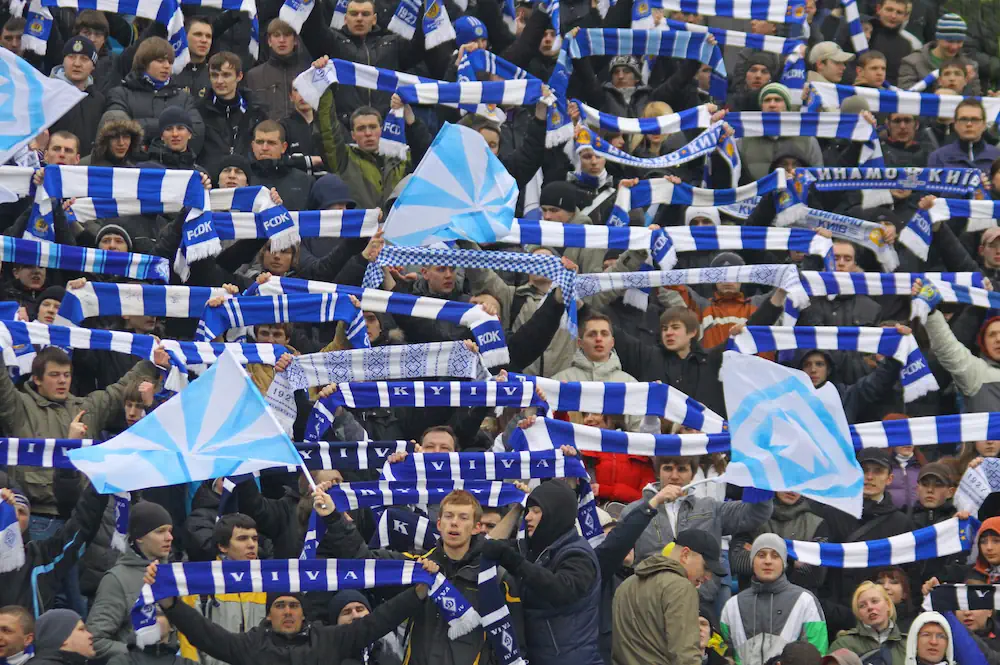
Dynamo Kyiv supporters during a match
Tactics Under the New Regime
Formation Flexibility and Pressing Strategy
Expect Dynamo to operate in fluid systems, alternating between a 4-3-3 and a 4-2-3-1 based on opposition and player availability. The backline typically builds with three players either through a dropping midfielder or an inverted fullback to create numerical superiority in the first phase. On the wings, one attacker stretches the back line while the other connects play, ensuring balance between width and central penetration.Pressing is designed to be simple but effective. A backward pass to a center back triggers the front line to jump. Trapped touches along the touchline invite surround presses, aiming to force errors or rushed clearances. When possession is lost, the team has a five-second window to counter-press aggressively before falling into a medium block to deny space behind.
Possession and Set-Piece Focus
In possession, the strategy emphasizes controlled build-up through third-man runs and flank rotations. Wingers and central midfielders interchange to create overloads, while underlapping fullbacks add unpredictability. The central defensive midfielder plays a pivotal role in dictating tempo, speeding transitions when opportunities arise. Shots are generally preferred from cutbacks rather than hopeful efforts from distance.Set pieces will be a crucial battleground. Dynamo is rehearsing routines designed to unbalance defenses, such as near-post crowding and delayed runs to the back post. Defensively, they will prioritize structure, line discipline, and second-ball recovery. Transition attacks will be sharp and deliberate, focusing on quick forward passes to exploit disorganized opponents.
Maximizing the Roster
Veteran Leaders and Their Impact
With the club in flux, veteran leadership is vital. Senior defenders anchor the back line and provide communication, while experienced midfielders dictate pace and manage high-pressure moments. In attack, seasoned forwards guide positioning and decision-making during crucial phases of play.However, balancing workloads is critical. Older players won't be able to maintain high pressing intensity across a congested fixture list. The coaching staff plans to rotate strategically, preserving key players for decisive matches and ensuring steady output rather than sporadic brilliance.
Youth Integration Strategy
This is where Kostyuk's strengths shine. He understands not just which academy players are ready, but how to introduce them effectively. The plan involves gradually promoting two or three young talents into the regular rotation by spring, with several others gaining experience off the bench.Support systems are essential. Young center backs will be paired with vocal, experienced partners. Defensive midfielders will operate between reliable veterans to manage pressure. The aim is to foster confidence and prevent the boom-or-bust effect that can derail a prospect's progress.
Transfer Needs Within Budget Limits
Dynamo's recruitment will be sharply focused. Three key needs have been identified:- A quick center back who can recover and defend in space
- A defensive midfielder with strong ball-winning attributes
- A winger with final-third quality
Given financial constraints, the club is targeting short-term deals, loan options, and undervalued players. Every signing must be able to compete for a starting role quickly. If a player cannot contribute within a few weeks, the preference will be to promote from within rather than adding unnecessary depth.
Competing in the Domestic Landscape
Tactical Approaches to Rivals
Dynamo's primary rivals remain Shakhtar Donetsk, along with dangerous challengers like Dnipro-1 and Zorya. Against possession-dominant teams, Dynamo will sit in a tight mid-block and look to counter in wide areas. Against low blocks, the focus will shift to fast ball circulation and well-timed runs behind the defense. Set pieces often determine the outcomes in these close games, making rehearsal and execution non-negotiable.Big matches demand discipline. The emphasis will be on compactness, controlled tempo, and smart possession. High-risk transitions will be limited, and the team will aim to dictate rhythm, not chase it.
Handling a Compressed Schedule
With travel complicated by security issues and the league calendar tightly packed, managing fatigue becomes a science. Training will be adjusted based on GPS tracking, with lower-intensity sessions and more video analysis during heavy periods. The coaching staff will maintain two rotating lineups to manage workload while keeping performance standards high.Travel itself becomes part of the preparation. Tactical briefings, nutrition management, and recovery plans are built into each trip. In this environment, mental and physical readiness must be maintained across all levels of the squad.
What Success Looks Like: Short- and Long-Term Goals
Metrics That Define Progress
Progress will be measured across multiple fronts. Key indicators include:| Metric | Target Outcome |
|---|---|
| Points Per Game | Above 2.0 |
| Goals Conceded | Significant reduction in soft goals |
| Pressing Efficiency | High recoveries in attacking third |
| Academy Minutes | At least 3 players with 1,000+ minutes |
| Set-Piece Goals Scored | Increase over previous season |
In addition to performance stats, internal targets will track how well the playing style is adopted and whether youth integration meets timelines.
Seasonal Milestones
The season is split into three key phases:- Autumn to Early Winter: Stop the negative trend, return to the top-three, and establish a recognizable playing identity. Two youth prospects should be moving toward regular roles.
- Winter Break: Consolidate fitness and refine systems. Reinforce weak areas in the squad.
- Spring: Push for European qualification, maintain consistent form, and solidify the presence of three to four academy graduates in the matchday squad. Ideally, by May, Dynamo should be in control of their league standing and European ambitions.
If these goals are met, the club will not only have recovered from its early season setbacks but also laid a foundation for future stability and growth.