
Clubs That Won League Titles in Two Different Countries
We previously published an article about clubs that had won league titles in countries other than their own, which were exceptional cases worldwide. However, we're now raising the bar and focusing on clubs that have won league titles in two countries - much rarer and more specific cases that are largely the result of unusual historical circumstances.Note that we are only focusing on league titles here, which is why we have excluded Canadian club Toronto FC. They did win the American-based Major League Soccer in 2017, as well as the Canadian Championship that same year, but the Canadian Championship is a cup competition, which is why we are excluding them here.
Rapid Vienna - Austria and Germany
Rapid Vienna (Rapid Wien) is one of Austria's oldest and most successful football clubs, having been founded in 1897. In 1912, they won their first Austrian league title, beginning a period that included several national league championships.In 1938, Austria was annexed by Germany, which meant that Austrian teams like Rapid Vienna had to participate in one of the various regional championships played in Germany at that time. Upon entering the German football system, Rapid Vienna won their first title there, the Tschammerpokal, the predecessor to the DFB Pokal. In the 1940-41 season, the Vienna team won their regional league, the Gauliga Ostmark, which allowed them to play in the German Football Championship, where the various regional champions competed.
Rapid was placed in Group 4 alongside 1860 Munich, Stuttgarter Kickers, and Neckarau, in which they finished first, scoring 24 goals in 6 matches and advancing directly to the tournament semifinals. In the semifinals, they faced Cologne 99, whom they defeated 4-1, maintaining their average of 4 goals per game. In the final, they faced Schalke 04, the most dominant team in German football at the time, and in fact, the match did not start well for the Austrians, as they were down 3-0 in the 58th minute. However, against all odds, Rapid scored 4 goals in 11 minutes and were crowned German champions.
Club Atletic Oradea - Romania and Hungary
The club was founded in 1910 as a football team in Nagyvárad (the Hungarian name for Oradea). It's important to note that at the time, the city was part of the Austro-Hungarian Empire. Unfortunately, when World War I broke out, organised football was suspended, and in 1918, after the war ended, Nagyvárad became part of Romania and was renamed Oradea.In 1921, Club Atletic Oradea began participating in the Romanian football system, and in the 1930s, they managed to form a strong team thanks to the "internationalisation" they experienced through tours of other European countries. In 1940, Oradea, along with other cities in western Romania, became part of Hungary, which was an allied country of Nazi Germany. In this context, some of the country's best players had to decide whether to stay in Romania and live under a military dictatorship, or go to Hungary, and that's how several of them ended up joining clubs like Oradea.
The club began competing in Hungarian football under the name of Nagyvárad AC. In the 1942-43 season, they finished second in the Nemzeti Bajnokság I (Hungarian football's top tier), and the following season they became champions in an impressive fashion, finishing 13 points ahead of second place with 24 wins in 30 matches. In 1946, after the war, they returned to participating in the Romanian league (Divizia A), which had been suspended for several years due to the situation in the country. In the 1948-49 season, they were crowned champions of the Romanian league, which was their second top tier league title (and so far, their last), both those two titles were obtained in different countries.
In 1958, the club, having such a unique past, having been born in the Austro-Hungarian Empire and having been part of Hungary, was not to the liking of the communist government of Romania at the time. Because of that, they decided to form a new club in the area which is now known as Bihor Oradea and began to make changes to the identities (colours, badge, etc.) of both clubs so that they would be similar. In 1963, when CA Oradea was also in a complicated situation, it disappeared. In 2017, it was refounded and began its journey through the lower categories of Romanian football.
©
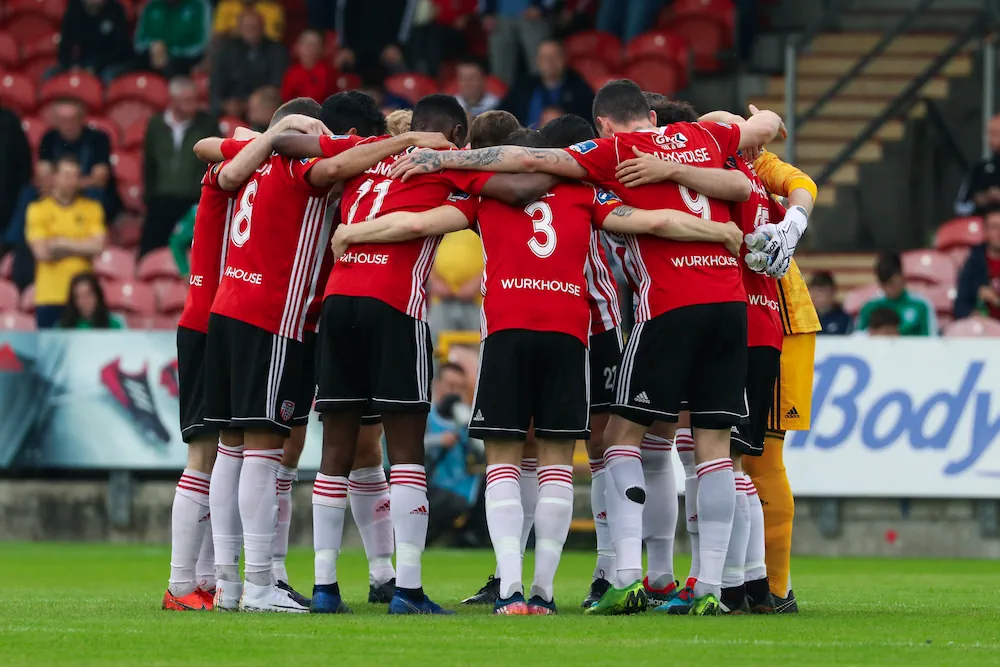
Modern version of Derry City players fire each other up before a match
Derry City FC - Northern Ireland and Ireland
Founded in 1928, the club joined the Irish League, the league of Northern Ireland, just a year later. The club was not particularly successful in the following decades, although they would lift a couple of trophies that brought them some national recognition. In the 1964-65 season, they achieved their first league success, winning the Irish League for the first (and only) time. This allowed them to participate in the 1965-66 European Cup and become the first Northern Irish team to win a tie in the competition, defeating Norwegian side Lyn.However, they were unable to participate in the second leg of the following round (having lost 9-0 in the first leg to Anderlecht) because the Northern Irish Football Association itself stated that Derry's stadium was banned for use by the Irish Football Association (IFA), sparking a conflict between the club and the association. Derry City was identified with Catholics, while the federation's leadership was mostly Protestant, and the club believed this was the reason for the ban.
When The Troubles escalated in Northern Ireland, the Derry area was deemed unsafe for playing football, leading the club to relocate to Coleraine to play its matches.
In 1972, the club decided to leave the league after various issues with the federation and remained an amateur club for 13 years until it applied to join the League of Ireland, the Republic of Ireland's league competition. The club entered the second tier but soon achieved promotion to the top tier, winning the league title in the 1988-89 season. That season made history by winning a treble, which included the league title, the League of Ireland Cup, and the FAI Cup. To this day, the club remains part of the Republic of Ireland football system.