
Bianchi's Boca Juniors: When The Viceroy had God's phone number
Clearly, some unions work more naturally than others, and for a time, the union between Boca Juniors and Carlos Bianchi was a formidable force for the rest of the clubs in Argentina and South America, and even, I dare say, Europe, considering their success in the FIFA Intercontinental Cup. Bianchi led a team that hadn't won anything in several years to become the best in its confederation. From there, the phrase "Bianchi had God's phone number" was born.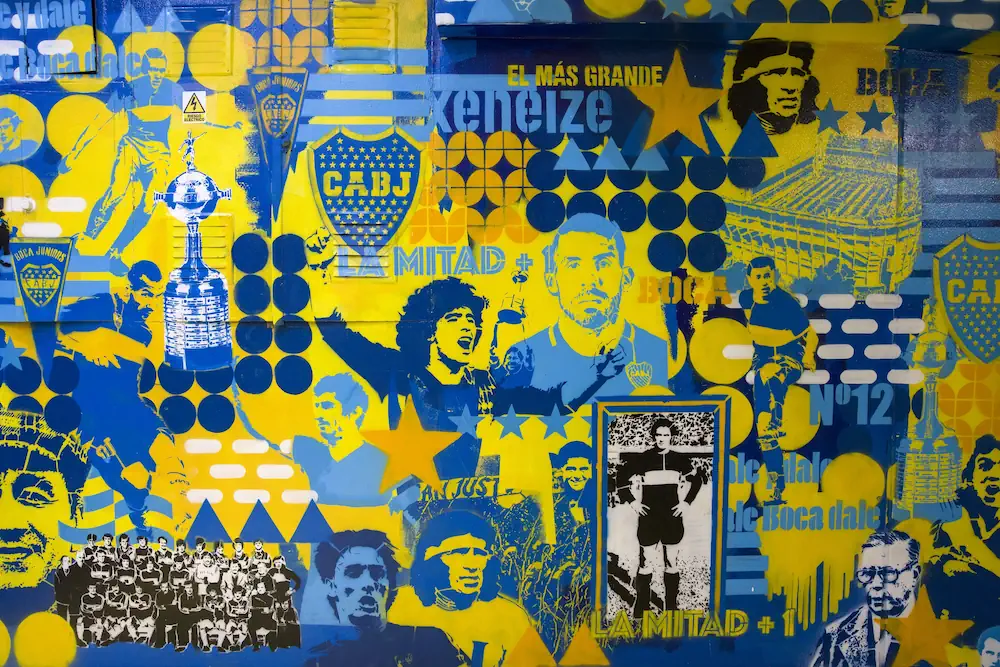
History of Boca Juniors
In April 1905, a group of Italians originally from Genoa decided to form a football club. At the time, the club wore very different colors (a white jersey with black stripes), although that would change only a year later. In a match between Boca Juniors and Nottingham de Almagro, a draw was held to determine who would wear their colors and who would have to change, as they wore very similar uniforms. Boca Juniors lost the draw and had to change its colors, adopting those of the Swedish flag, as it was the flag of a ship that was near the La Boca neighborhood.In 1903, they entered the Argentine First Division for the first time, as the number of participating teams expanded from 6 to 15, and the Xeneize (one of the nicknames for Boca Juniors) team took advantage of this to reach the top tier. Just three years later, they would begin to place trophies in their display cases, winning the Argentine league along with other trophies of the era such as the Jockey Club Cup, the Ibarguren Cup, and the Tie Cup. Thus began eras of success for the club during the 1920s, 1930s, 1940s, and 1960s, becoming one of the leading football clubs in the South American country. In the late 1970s, they won the Copa Libertadores for the first time (twice) with that team, coached by Juan Carlos Lorenzo and featuring players such as Hugo Gatti and Ernesto Mastrangelo.
The arrival of Bianchi
In 1998, The Viceroy (Bianchi nickname is El Virrey, translated to The Viceroy) in English) had just finished managing Roma (without much success) and received the opportunity to manage Boca Juniors, building on his successful tenure at Vélez, where he gave them their best spell in history. At the time, Boca had gone six years without winning a title (the last being the 1992 Apertura), and their last Copa Libertadores title was in 1978. The club's fans had already grown accustomed to disappointment, and that's why the board was looking to change the way they managed things. Bianchi was tasked with bringing about a "generational change" to the team, which had been managed by Hector Veira without much success. This is how important players like Fabbri, Latorre and Caniggia left the Xeneize club, something that did not encourage increased excitement among the fans.
Martín Palermo
A return to the best times
Bianchi opted for a starting eleven that could almost be described by heart a few months later, seeking to help the team get to know each other and develop the automatisms that would allow them to have a defensive solidity that would win matches. In the early matches, the team had obtained good results, although they were conceding more goals than their manager wanted (12 goals conceded in the first eight matches). However, after a 1-1 draw against Racing in Avellaneda, the team began to demonstrate the solidity Bianchi so sought, with five consecutive matches keeping a clean sheet.The coach's obsession with defense stemmed from his awareness of the offensive power he possessed with Riquelme as the playmaker, Guillermo Barros Schelotto assisting, and Martín Palermo scoring. Palermo scored 20 goals in 19 matches, out of the team's 45 goals, averaging 2.4 goals per game for the team. Boca Juniors finished the 1998 Apertura tournament without losing a match, with the defense conceding the fewest goals and the offense scoring the most. And most importantly, winning a title for the first time in six years. In the 1999 Clausura tournament, Xeneize would repeat as champions although this time they suffered a painful defeat against Independiente by 4-0.
Having established themselves in Argentina, the goal became the Copa Libertadores. In 2000, Boca Juniors had a difficult path to the final, as they faced their bitter rival, River Plate, in the quarterfinals. They defeated them 4-2 on aggregate after losing the first leg 2-1. In the semifinals, they faced Club América of Mexico, a tie that ended 5-4, with the Mexicans coming very close to equalizing the aggregate in the second leg. In the final, they faced Luiz Felipe Scolari's Palmeiras, whose main players were Marcos, Roque Junior, Cesar Sampaio, Faustino Asprilla, as well as Alex, who was their main star player.
At La Bombonera, the match ended 2-2 with a stunning double from Rodolfo Arruabarrena, and in the second leg, played at the Morumbi stadium in Sao Paulo, the score was tied at 0-0. This sent the final to penalties, which Boca won 4-2, thanks to an impressive performance from Oscar Cordoba. Thus, the Argentine club won its third Copa Libertadores in its history and its first since 1978. At the local level, they continued their dominance by winning the 2000 Apertura tournament, their third consecutive one. Added to this is the fact that they beat Real Madrid in the Intercontinental Cup that year.
In the 2001 Copa Libertadores, they again reached the final, this time defeating Vasco da Gama and Palmeiras in the preliminary rounds. Cruz Azul awaited them in the final, having eliminated two Argentine teams (River Plate and Rosario Central). The visiting team won each leg 1-0, leading to another penalty shootout in the Copa Libertadores final, where Xeneize again emerged victorious, defeating the Mexican team 3-1. Decisions such as the sale of players from the board and disagreements with the club's president led Bianchi to leave the club in 2001. In 2003 he returned to the club, which had not won anything during his absence, to once again lead them to become champions of Argentina (Apertura 2003), America (2003 Copa Libertadores) and the world (2003 Intercontinental Cup).
All those titles - and the absence of them when he was gone - underscore just how vital Carlos "The Viceroy" Bianchi was to the Buenos Aires club.